
Emeline Binkley, Special to The Denisonian–
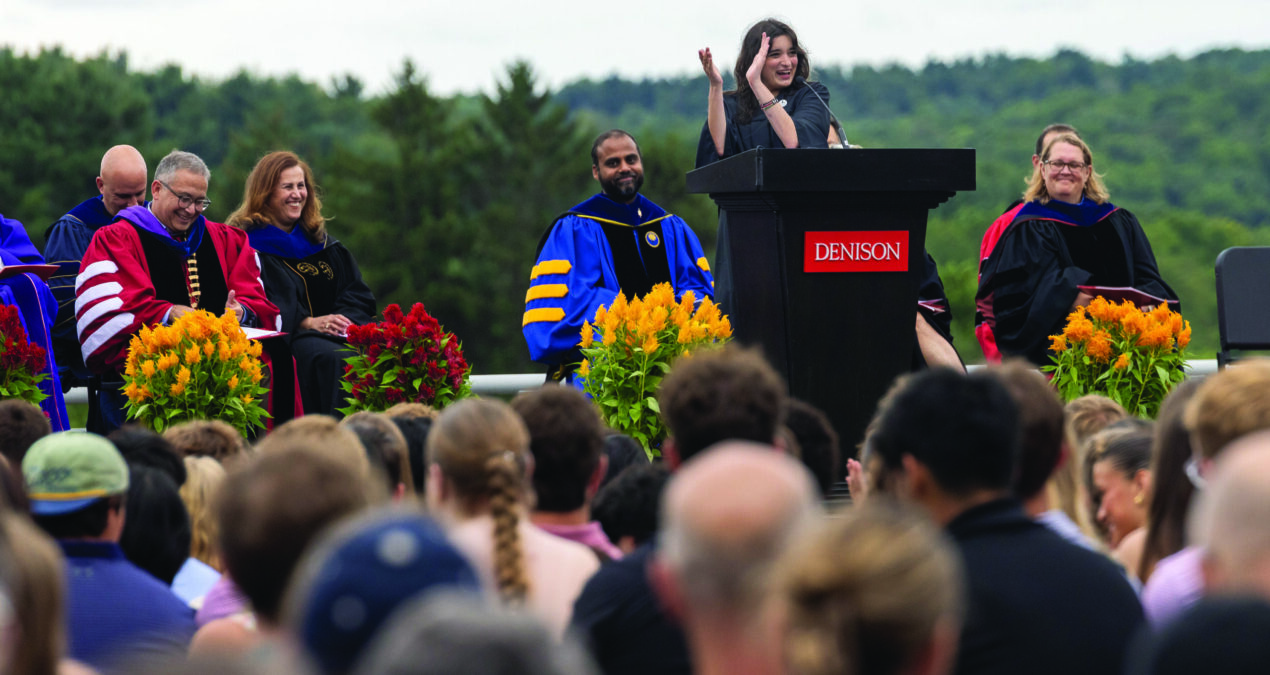
The Denison Campus Governance Association (DCGA) President Norah Carter ‘26 has three main things she’ll be working to achieve this year: financial autonomy, accessibility and general engagement with the student body.
She stressed the importance for students to know where Denison’s finances are allocated.
“We have that endowment, but we don’t really know [where] it’s going,” she said. “Since we all either pay tuition or [have] scholarships [that] pay for us to be here, we have a vested interest in knowing that. Especially morally.”
In terms of accessibility – another one of her main focuses – there’s one goal she’s had for a long time that she hopes to finally implement this year.
“I really would love to get a shuttle on campus. It’s something I’ve been advocating for since I first joined Senate as a freshman, and it just hasn’t happened,” Carter said.
Disability advocacy has been the main motivating force behind her work in DCGA. Carter has always been someone who recognizes where change is needed, and that it requires action.
“I knew coming into college that I had a big passion in disability rights already,” Carter said. “Things were set up in a way that didn’t necessarily work for me. And so I always knew I had to advocate to change that.”
Carter described the connection between disability rights and politics.
“As I grew older and I became more invested in politics, I realized how much of our system is tied to ableism, and it’s something that people don’t talk about a lot,” she said.
Her freshman year, she created the Denison Disability Advocacy Association (DDAA), catalyzing her involvement in student government.
“We don’t have elevators in all the buildings, and some of our stuff isn’t ADA compliant. So to advocate for better [accessibility], I started that club,” she said. “We got a seat on the Senate for it.”
One significant part of Carter’s time on DCGA was her role as chief of staff. She was the first person to ever take up that position, which involved controlling and seeing to all the governance committees.
“That was definitely a challenge: defining that role, and figuring out how to do all that,” she said.
Another major point came in early 2024, when Carter altered DCGA’s definition of anti-zionism.
“I changed the policy around [DCGA’s] definition of anti-zionism because before, it did not properly define that anti-zionism and antisemitism are two separate things, and that you’re allowed to advocate for anti-zionist policies without committing hate speech,” Carter said.
Changing the definition of anti-zionism was a challenging process, but one that she was able to be proud of. It reflects her strong commitment to advocating for students.
“That was a very controversial policy when I passed [it], and it took a lot of meetings and a lot of work to prepare. That was the first policy I’d ever actually passed,” she said. “I feel proud that I was able to protect that group of people better.”
Carter has also become a political leader at Denison in a time of political turmoil and uncertainty, especially around college campuses.
“Right now is a really weird time to be student body president, because it’s a time where I’m supposed to be advocating for an academic institution that the federal government is actively trying to take away,” she said.
Carter puts a lot of effort and care into fulfilling her role as president; in fact, her senior research is focused on how she can best carry out her responsibilities in the context of the current political climate.
“This is actually what my senior research is about: how to be a good activist [in] my role as student body president, at a time where it seems like all of the values that I’ve been fighting for are being rolled back by institutions out of Denison’s control,” she said.
DCGA hosts a Town Hall once a month, and Carter commented on the value of student engagement. She urges the Denison student body to interact with DCGA and bring up any subject that they find important.
“I’d like to make it clear that anyone is welcome to come to Senate at any time to share any issue they want,” she said. “Student government can be a really big source of power, but it cannot be that source of power alone. It needs the student body and their willingness to participate in the system.”