
Katey Woodruff, Features Editor–
A quick walk around campus on a Saturday or Sunday morning will reveal cans and red Solo cups littering the ground; evidence of the parties the night before.
Aluminum cans have a national recycling rate of 43%, which is higher than the average recycling rate of 32.5%. However, according to Miles Boyko ‘28, college campuses, including Denison’s, are far behind this average.
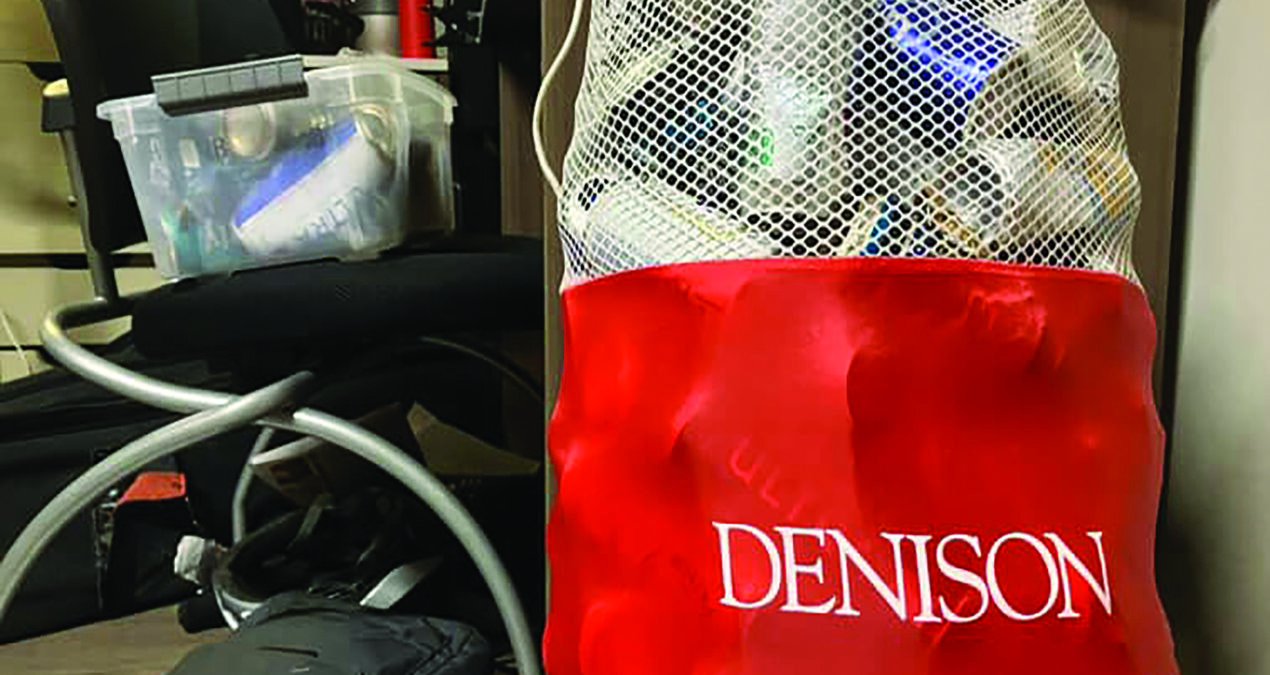
Boyko, discouraged by the recycling system’s way of dealing with aluminum cans, took it upon himself last October to begin collecting the cans in garbage bags and taking them to a scrapyard, either in Newark or Hebron. There, he sells them for 60 cents per pound. He estimates that he takes about 25 pounds each trip, generating some profit.
“The main reason I continued doing it is, on a personal level, knowing that the money I have for my Snagel was because I recycled cans and because I took carbon out of the environment,” Boyko said.
Many students can see him around campus, pulling a trailer filled with garbage bags on the back of his bike or snapping on his gloves to pull them out of waste bins. He begins his route at the Shorney dumpster, then makes his way through the senior apartment areas and then north loop, where the fraternity houses pile up the cans in their lawns. He also has friends who leave out bags for him to collect.
Boyko has always been passionate about recycling and sustainability efforts, but struggled to start any official initiatives at his high school in Saint Louis, Missouri, despite pitching it to the sustainability club multiple times. For this reason, he has been discouraged from trying to collaborate with any sustainability classes or official projects.
“It’s talked about for one or two meetings and then fizzles out. People don’t really do anything about it, and then I’m like, ‘OK, well, I’ll do it.’” Boyko said. “People don’t really do anything, and just all the momentum is lost. So I haven’t really collaborated with anyone because I feel like eventually that would just lose my motivation to do it.”
According to Boyko, Denison lumps together most kinds of recycling materials, leading to it not being efficiently taken care of. There is also a large problem with students stuffing paper waste into cans or plastic bottles, which then makes the bin of material unusable. Most local recycling plants don’t accept mixed materials because it is harder to find a buyer for it or to break it down properly.
“That just ruins the entire thing. The main thing is people knowing that and people being more attentive of their waste,” Boyko said.
His suggestion for a future better recycling system is that Denison provide more clearly-labelled bins for students to sort their recycling.