
Donald Keough, News Editor–
Arianna Griffiths
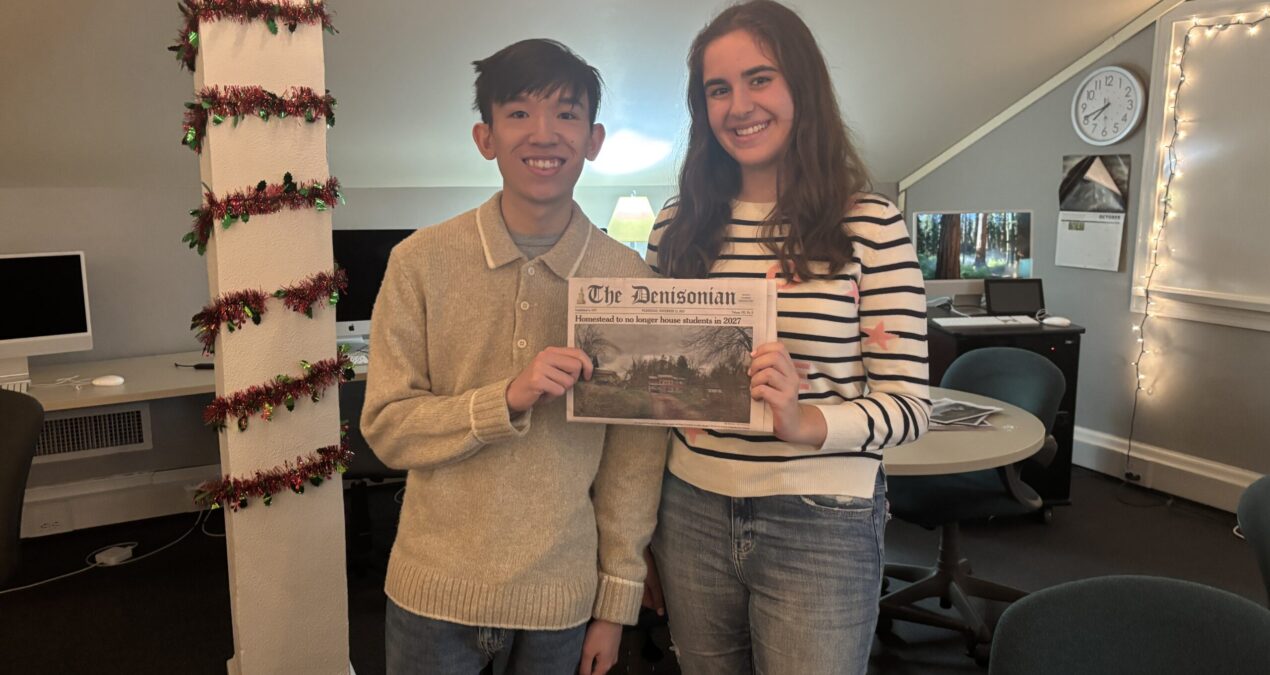
During the semester’s final content meeting on Dec. 1, Arianna Griffiths ‘26 spoke to the editorial staff after reviewing story assignments.
“It is hard to sum up years of the college paper into a few minutes, but I think the following simple phrase will do it. I will miss this,” Griffiths said.
This was Griffiths’ final content meeting. After four semesters of leading the paper as an editor-in-chief, she will be stepping aside.
Griffiths has been heavily involved with The Denisonian since she enrolled at Denison. Even before arriving on campus, her “Why Denison” essay in her college application talked about her interest in the paper.
“I was just so interested in the whole idea of the newspaper that I just wanted to be as involved as possible,” Griffiths said.
She still remembers her first content meeting.
“The first content meeting I was sitting on the opposite side of the J-space from the editors, and I remember feeling, as a freshman, a little bit scared,” she said.
Initially, she took photos each week, mainly of sport events, and she said the paper’s weekly schedule made it easier for her to form a routine as a freshman.
But an email from the editor-in-chief at the time, Aaron Skubby ‘23, telling her that Alex Moffat ‘04, a “Saturday Night Live” cast member, was coming to campus helped push her to write her first story.
“I’m a huge SNL fan, so I’m like, ‘I have to cover that,’” Griffiths said, even though she didn’t have much experience writing stories.
She went to a talk he was giving, and she remembers him calling her out during the event while she was taking notes. She got to meet him after the talk, and the story was published in the next edition.
“At one point when you Googled his name, my story came up at the top, and I loved that,” Griffiths said. “It made me realize what a big doorway journalism is to all these crazy opportunities, and being on The Denisonian gave me that.”
Although there are many reasons Griffiths stayed involved with the publication, this story motivated her.
“After [writing the story], I realized how much I love to write, and I dropped the photography thing and kept writing. I wrote and wrote and wrote.”
Griffiths’ time on staff included being a staff writer for one semester, an arts and life editor for the following two semesters and editor-in-chief for the past four semesters. There have been 39 editions published under her current tenure before this one.
“It’s not been without stress,” Griffiths said. “It’s been a very hard, but extremely rewarding job. I’m proud of the work that we’ve all done together. I’m proud of the staff that we have…I would do it again in a heartbeat.”
Griffiths is a psychology major, and doesn’t plan to pursue a career in journalism, but said a lot of the skills that she’s learned are transferable.
“I’ve learned so much from The Denisonian about leadership, writing skills, copy editing, management and everything in between, and I’m definitely going to take them with me wherever I go after this,” Griffiths said.
And even if she isn’t involved heavily with the journalism department, there are many things that she found which make her passionate about the paper. She found joy in sending articles to her family, saying it “made me feel like I was here for a reason, and I was doing something purposeful with my time.”
She also said that The Denisonian made her more aware of what was going on on campus that she normally would never know about. Perhaps the biggest reason she continued to write was the impact she saw her stories make on the community around her. One example was a story she wrote on the groundskeeping staff after they were recognized nationally for their work.
“I got an email from the head groundskeeping staff member he was like, ‘Thank you so much. This morning, I woke up and saw this, and I got to share it with my team, and it made everyone [on our team] feel seen by the students, and I can’t thank you enough,’” Griffiths said. “It was in that moment that I was like, ‘wow, what I do really matters.’”
Although writing articles like this didn’t come easily when she was first starting, over time she said that experience helped improve her process.
“I got more confident over time the more I wrote, and receiving feedback from editors was really helpful,” Griffiths said.
For new writers, she thinks the first step to improving and enjoying writing is to try.
“Just show up and give us an article,” Griffiths said. “Even if it isn’t perfect, we want to read your writing. We want your voice to be heard.”
Remembering the importance of her stories is also something she said helps get over any apprehension one may have about writing.
“Telling people’s stories was important enough to me that I was willing to override any nervousness I felt,” Griffiths said. “Even though it was daunting, working with the editors and just asking them questions and realizing that they are my peers… helped me write.”
Griffiths said that she knew early on that she wanted to be editor-in-chief, and so she made sure to show up to every content meeting. She never missed a content meeting during her time at Denison.
“I just put my head down and worked to prove myself to the editors that I was worthy of consideration despite not being a journalism major,” Griffiths said.
She said that when she applied, she was so excited that at the dinner before her interview she could “barely eat” and that she had worked on a list of all of the things she wanted to do in The Denisonian to tell her the previous editor-in-chiefs interviewing her. She said that she’ll “never forget getting the email” telling her she got the position.
“When I got picked I freaked out,” Griffiths said. “My roommate gave me a huge hug, and then I ran up to my other best friend’s room on the fourth floor of East Hall, and I pounded on her door and she went, ‘Oh my God, you got editor-in-chief?’ But she just knew from the look on my face.”
She started in the position her spring semester of her sophomore year. As a 19-year-old in the position, she said it was weird running the paper and having seniors report to her. But remembering how much she wanted guidance as a writer helped her fulfill the position.
“Stepping into the role was a little overwhelming at first, but once I did it a couple times, I got the flow of it, and now I can do it with my eyes closed… almost,” Griffiths said. “I mean, it was hard, juggling school and friendships and that all at once was a lot, but I knew how much I wanted it, and I was so dedicated to it that I would do anything for it. I was just all in on The Denisonian.”
On top of her social life and her work with the paper, she also writes for The Bullsheet and is a part of the psychology honor society. Even though she was able to become more efficient as time went on, she said that “every week is different with the paper.”
“It took me a while to learn because there are all these behind the scenes things and forms that you fill out that people don’t know about,” Griffiths said. “Once I learned how everything works, it became standardized. But when it comes to judgment calls, when [you’re] deciding to pull an article… There are tons of surprises that’ll come your way that you don’t even anticipate, but you have to use historical precedence to help make decisions and just hope that you’re doing the best that you can.”
These tough calls are challenging to navigate in the position, Griffiths said. In the beginning of her tenure, she also had to learn how to publish articles she may not have agreed with in the opinion section, and she had to learn how to deal with articles that Denison administration may not have wanted published.
“It was a lot of responsibility as a sophomore, but as a junior and senior, it felt a little bit more natural, and I was in the swing of things,” Griffiths said.
She also said that working with the editors around her helped her succeed within the role. In her first two semesters, she worked with Ellie Owen ‘25, also editor-in-chief, and Max Dolinh ‘26, managing editor, however for her last two semesters she worked with just Dolinh as he became editor-in-chief after Owen left the position as she was a senior.
Griffiths had previously worked with Owen as arts and life editors as well. She considers her a friend too.
“We were kind of newer to the [arts and life section] at the same time, so we learned the ropes together, and then going from learning to leading together was really fun,” Griffiths said.
And in their positions leading the publication, Griffiths said that they “made a really good team.”
“[Owen] was super good with journalism knowledge, and I loved recruiting people to come join the staff,” Griffiths said. “So together, we made such a good team, and Max… did a lot for us on the administrative side so that we could focus on more of the writing. So we made a really dynamic trio.”
After Owen’s tenure finished, Griffiths said that she had already been working with Max to the point where they had to figure out where Max and I’s talents could cover what Ellie used to do for us.”
“After a couple additions, [Dolinh] and I had it down,” Griffiths said. “I feel like we’re the most efficient right now. It feels really good to have the paper done in record time compared to when we started.”
Griffiths said that she’s loved working with Dolinh.
“He is so good at InDesign, but also is so talented when it comes to The Denisonian, so meticulous in his attention to detail, he’s great,” Griffiths said.
She also said that she appreciates the support she has received from the paper’s advisor, Lee Cochran.
“He is such an amazing person and advisor, and I call him on the phone anytime I have a question,” Griffiths said. “He’s always available. He’s so knowledgeable in the subject, and he doesn’t give himself enough credit, and he has helped me and [Dolinh] both learn everything there is about journalism, but also make sure we feel supported while running this paper and managing this staff. We’re very grateful for that.”
As she finishes her time in the position, she reflected positively on the experience.
“My favorite thing, probably, about being editor-in-chief is watching people learn how to become better writers over time, and seeing them get their work published and that excitement that they get,” Griffiths said. “That has been really gratifying, and that’s something that I have learned a lot from being an editor.”
She didn’t say that the job was easy, however.
“It’s such an emotional commitment for me,” Griffiths said. “I get so invested in The Denisonian that, when it goes well, it’s such a high, and then when it goes poorly, it ruins my day.”
This emotional rollercoaster is something that she said will be weird to live without. But she’s also excited to say that she accomplished most of her goals that she set out to achieve, such as starting the weekly professor spotlight, stories with Denison President Adam Weinberg and building up a confident staff.
In addition to her goals, she wants to make sure she’s leaving the current staff with advice that they can carry throughout the rest of their time with the paper.
“You’re so lucky,” Griffiths said, referring to current students. “You still have all these years ahead of you at Denison, take advantage of them. Dive in, whatever it is, whether it’s The Denisonian or something else on campus, I urge you to get involved and be part of the story, because you’re going to look back one day and the years will have passed. I love The Denisonian because it gives me a sense of community, a sense of purpose, and something to do each week. So whatever that is for you, I just hope that you find that and go chase it, because that’s what we’re all here for.”
Although she said that she hasn’t quite accepted leaving, she is looking forward to seeing how everything goes for the paper.
“I have a lot of confidence in the people that are taking over after me,” Griffiths said. “I see a lot of my enthusiasm and excitement being carried on by them, and it makes me feel okay leaving.”
The Denisonian staff will greatly miss Griffiths. She led with a fierce compas sion, and her support for her writers and the stories she told will leave a lasting impression.
“I will always read our stories and be thinking of you all,” Griffiths said. “The Denisonian will always have a special place in my heart.”
Max Dolinh
Max Dolinh ‘26 was walking through the involvement fair the fall of his freshman year when he saw Aaron Skubby ‘23 and Lula Burke ‘24 tabling for The Denisonian.
“They had a laptop that said, put down your email here, we’ll put you on the email list,” Dolinh said. “I thought, ‘I did the paper in high school, so it would be something that might be fun to do in college, and I’d love to join because everyone wants to get involved when they’re a freshman.’”
Dolinh assumed that there was a college paper after enrolling at Denison, but it wasn’t something he was immediately interested in doing. But after he put his email down, he went to an informational session for The Denisonian hosted by the editors.
“Honestly, I wasn’t sure if I wanted to continue going after the meeting, but out of all the clubs that I saw, the newspaper seemed like the one I’d be able to be the most involved in,” Dolinh said.
Following the session, he went to his first content meeting the week after. He said it was “packed to the brim,” and that he barely had a spot to fit in.
“I didn’t love the whole writing process, but there were so many people there, and it seemed like they were all eager to start writing, I think I was a little intimidated by that fact,” Dolinh said. “But because there were so many people there, I also wanted to come back because this is something that people are really involved in and interested in, and if I’m able to be part of it, then that’d be pretty cool.”
He didn’t sign up to write that week, but the editors said that people could talk to them after the meeting if they knew how to work with InDesign, a software program used for newspaper layout. Dolinh had written for his high school paper, so he had some knowledge of the program.
“I introduced myself after the meeting, because I knew how to use InDesign, and they were [looking] for editors and people who knew [InDesign],” Dolinh said. “So they invited me that Sunday, and I helped place the news section.”
He said that he still remembers placing a story about Narcan being put in buildings on campus during that first Sunday placement meeting.
“One thing led to another, yeah, the rest is history,” Dolinh said.
This semester marks Dolinh’s final semester as editor-in-chief for The Denisonian. His InDesign skills helped him land his first position on the paper as an assistant sports editor, and eventually he was promoted to sports editor the spring semester of his freshman year. He went on to become the managing editor of the paper the spring semester of his sophomore year. He became editor-in-chief his junior spring semester.
The end of Dolinh’s position comes with mixed emotions.
“It’s odd, because it feels like yesterday when I was sitting in my Writing 101 during my fall semester of my freshman year,” Dolinh said. “But I’m at peace with it, and also I’m happy because at this point it feels like the culmination of everything. I think it’s the right time to be done.”
Becoming an editor early into his freshman year came with its challenges. But he enjoyed covering sports, and had some experience writing about the topic in high school.
“Luckily, I knew InDesign, so that part wasn’t hard for me,” Dolinh said. “I knew how to write about sports, so the job wasn’t too much of a leap.”
Part of why he believes he was able to earn the position was because of his attention to detail.
“I think there were qualities that they noticed,” Dolinh said. “I would make sure that all stories were edited with AP style and that all the pages were within the lines, because that’s just something I naturally should care about.”
At the beginning of his sophomore year, he got an email from Burke telling him that they appreciated his work in the sports section, and encouraged him to consider staying with The Denisonian because of his commitment so far. He said that the email played a role in why he decided to stay with the publication.
“It’s always nice to be recognized for what you’re doing,” Dolinh said. “When I got that [email], it was really what made me think about wanting to be something more for The Denisonian.”
By the end of his first semester sophomore year, he knew that the managing editors/editors-in-chief were looking for students to replace them. He realized that he was probably one of the editors who cared the most about The Denisonian, and that maybe he could use his skills to help the paper on a larger scale.
“I loved the paper, and I wanted to stay with it,” Dolinh said. “At that point, it felt natural to step up.”
Even now, Dolinh doesn’t plan on becoming a journalist in the future. He’s graduating with a Bachelor of Arts in economics and data analytics, which he said is weird to think about since his majors don’t relate to the paper in many ways. Nonetheless, he still thinks that being on staff has been an important experience.
“My path to the paper was different from a lot of people’s reasons for joining it.”
The people who he works with are another reason that he decided to stay with the role.
“Being able to help our current staff, who are really passionate about making sure that the sections and every story is good… is really fulfilling, even though I’m not the most journalism-oriented person.”
Being the editor-in-chief has come with advantages and disadvantages for Dolinh. Making sure that the paper has five sections which are filled is one of the stressors he has faced.
“We take pride in making sure that all five sections have stuff that is worth printing, and especially when the content meeting doesn’t go as well as we want to, during the week I have to think about what we can do to make sure that it all comes together,” Dolinh said. “When a story has a lot of hoops to jump through, as the editor-in-chief you have to step in to help someone with a contact or make sure that the writer isn’t overwhelmed by writing a story.”
In the role, he also has to make sure that he can get enough writers to sign up for stories, which can be tough, in his opinion.
There are a number of “little things that come with making sure the paper stays afloat” that he has to keep in mind as well, but he said that he knows that it’s always going to work out in terms of content.
“Some days used to be more stressful, I’d say, because we just didn’t have [enough] involvement,” Dolinh said. “I think involvement has improved this semester, so I don’t feel as powerless when we don’t have people to write and contribute.”
Dolinh said that the job also comes with its upsides.
“Every week when you see the paper come out, and you say, ‘I was a big part of that,’ and people are happy about stories, or they’re just talking about something that someone has written… being able to know you were part of coming up with that idea, or editing that story, that’s always the best,” Dolinh said.
As a managing editor, he first worked with Griffiths and Owen who were the at the time current editors-in-chief. These past two semesters he has worked with just Griffiths after Owen’s tenure finished as a graduate last semester.
Dolinh attributed much of his success to his partnership with Griffiths.
“We understand each other so well,” Dolinh said. “When you’re running a paper or being the person in charge, you might have conflicting ideas with the people you’re working with. But because [Griffiths] and I understand each other on such a good level, we’re always like, ‘this is the right thing to do.’ We’ve had so many conversations, and our dynamic is really strong.”
He also said that working with her has brought them a lot closer.
“I never would have imagined that we’d be so close to each other and know so much about each other,” Dolinh said. “We have different strengths, and that’s what I appreciate the most, that we’re good at different things.”
Reflecting back on the 39 publications he’s been a part of since becoming managing editor, Dolinh said that he is grateful for how much was accomplished.
“It’s a hell of an achievement that we put out an eight-page paper every week,” Dolinh said. “Some weeks, when it does look really good, we can celebrate because it is hard. Even though I think that the paper has a lot more potential to put out really good quality week after week, I accept that the paper, when we started working on it, has improved a lot. Our standards have grown and the overall quality has risen, and that’s something I can take pride in.”
A lot of this growth, in his opinion, comes from a gradual increase in expectations. He said that it’s hard to measure how far the publication has come, but by looking at the ways editors carry out their work, he has seen improvement.
“Every single person is someone that [Griffiths, Owen] and I have picked in some way,” Dolinh said. “Knowing that [the editors] are taking on the things I want to see in an editor… you don’t realize it when it happens, but when you look back, it’s like ‘wow, the standards have really changed around here.’”
He also said that he appreciates the amount of care the editors put into doing the section, and that they are willing to write thorough stories.
“The stories we get on average are a lot better stories than we used to get when I was a freshman,” Dolinh said.
With his departure, Dolinh said that he still has some closure with the idea of leaving, even if it is bittersweet.
“I’ve taken The Denisonian as far as I can take it as editor-in-chief,” Dolinh said. “I’ve instilled what I wanted to do in terms of standards to where we have a better system now, to where I think we can be a lot more efficient. I also love seeing people so happy at the end of the content meeting, when Lee (Cochran, Advisor for The Denisonian) goes through our spread and calls out what they did well. So now, after 39 issues, it feels right to step away. I don’t know if I’m ready, per se, to leave, because it’s just been my life for the entirety of college, but at the end of the day, l’ll be OK.”
Dolinh also attributed part of the success he’s found leading the paper to Cochran.
“I have closure, because I never would have imagined I would be where I am in terms of leading the paper and being able to help so many people, and realizing that they really appreciate me… I don’t think it gets better than that,” Dolinh said.
One of the final acts that Dolinh is excited to carry out is signing the editor-in-chief couch, which the outgoing editors-in-chief sign as their tenure ends.
“You look at the couch, and there’s so many people who’ve written their name on it… as a final reflection, since it’s so intertwined with the four years I have in college, it’s weird to have to say goodbye.”
As he leaves, he is confident that the future staff can maintain the standards he helped instill.
“The paper is in good hands.”