
Donald Keough and Lilly Andrews, Editor-in-Chief and Asst. Arts & Life Editor
Orientation will be different this August for first-years as the university reexamines what is prioritized for incoming student acclimation.
The most notable changes include ceasing all overnight trips, shortening the number of programming days from six to five and shifting induction to the day before classes.
Some of these alterations aim to bring students closer to campus, or the first-year quad. There will also be a series of day trips for students to Columbus.
“We had the benefit of assessing and looking at what’s been an overwhelmingly effective and successful First-Year Quad,” said Dr. Ricardo Hall, the vice president for student life. “We made a conscious decision to lean into students’ sense of belonging, for an affinity to Denison, specifically the First-Year Quad.”
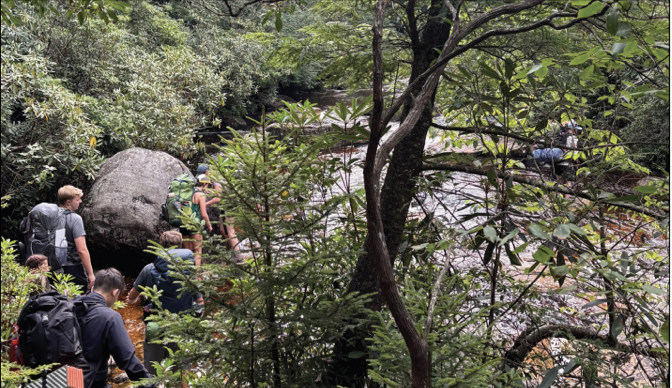
Overnight trips in the previous orientation were offered to almost all first-year students. There were a variety of trips offered in the past, and many of these trips garnered a mixed bag of reactions.
Mackenzie Kinnie ‘29, who was on the Denison Outdoor Orientation trip (DOO), described her trip as “the most insane experience of my life.”
“We walked miles and miles, and I fell in thorny bushes,” Kinnie said. “But by the time I got out of those woods, there was a smile on my face. I was glad I did it.”
Another student, Josie Knee ‘29 was a part of the Written in the Stars trip. Her group stayed in YMCA Camp Kern, which she said was comfortable but a little confined.
“I felt that written in the stars was, at some moments, very relaxing and a nice break from the otherwise chaotic orientation,” Knee said. “I also felt that it helped me connect with students for a longer period of time than most days during orientation allowed. But also I didn’t love the activities we did and I didn’t feel that the actual experience matched my expectations based on the description.”
Lucia Castaneda ‘29, who was a participant in the Denison Service Orientation, said that she enjoyed the trip her group took.
“I would’ve liked to do more since there was a day where we separated into groups to do different service stuff,” Castaneda said. “One group basically just moved benches at the camp we were staying at and that was it, while the other groups actually went out and did stuff. Other than that, it was a good experience.”
She also said that she liked the cabin they slept in, saying “it had normal sleep-away vibes.”
Some trips focused less on the outdoors aspect and more on a specific activity. Henry Neely ‘29, for example, was a part of Session Zero, a Dungeons and Dragons board game trip.
“I had fun playing DND and other games, and I liked my Dungeon Master, Zacc,” Neely said. “I didn’t love the cabin as much, and I had one of the good ones. The food was OK. I liked the experience overall, and I made a lot of friends. I’m still glad I did it.”
In addition to the outdoors or activity focused orientations, there were also some Columbus related trips which first-years went on. These trips, which will likely be most similar to the new day trips, only without the overnight stay, also had a number of different reactions from students.
“I liked that [Taste of Denison] was in Columbus because I got to see a little bit of the city, especially when we went to Easton,” Meredith Havre ‘29 said regarding her experience. “I was a little underwhelmed because it was marketed as this cooking experience. I really liked to cook, but we didn’t do any actual cooking. It wasn’t exactly what I expected, but I think the experience did help with meeting new people.”
Students’ feedback from these trips were a large consideration of the overall decision to change the first-year orientation.
“We’ve always and will continue to survey students on their orientation experience,” Hall said. “It’s what allows us to take a good look at orientation and then, in some instances, tweak the offerings.”
He also said that the administration has received helpful data from students thus far.
“You all are very forthcoming,” Hall said, referring to students’ answers to surveys.
There were also a variety of logistical considerations when deciding to change orientation. Some considerations included accounting for students who already live in Columbus given that the upcoming orientation will be closely tied to the city.
“Some of our students are from Columbus, but it’s a very small percentage,” Hall said, saying that they hope to outline the city differently than how these students may have already experienced it.
These Columbus day trips will also have different categories of activities.
“We’re not just going to randomly assign someone to… something they have no interest in,” Hall said.
The decision to remove the overnight aspect of the trips was also because it will help more incoming students participate in all areas of orientation, as student athletes would sometimes need to opt out of overnight trips for practices.
“We fully anticipate being able to include just about all of the students,” Hall said.
He also said the university’s focus is on bringing students closer to campus instead of taking them further away from campus on trips.
“Some of the students went to other states, which really had no ties to Denison… So a better use of their time and the university’s resources is doing something a little bit closer to home that still gives students an opportunity to form these bonds,” Hall said. “These are the newest members of the community. They don’t know Denison yet, and we want to make sure that we’re as a community, putting our best foot forward and being intentional about them, forming relationships, forming lasting friendships and reinforcing to them that this is your home.”
Some students who advocate for the trips have spoken out against the changes. Hall said that the administration takes student sentiment into consideration and has started discussing implementing certain trips elsewhere.
“We can’t discount that [those orientations] were impactful and important to those students,” Hall said.
One example he gave was the white water rafting orientation trip.
“We own that equipment and we made a significant investment in it,” Hall said, also saying that he believes these orientations will be implemented in different ways. Currently, there are no official dates set of when these may occur, or the exact fashion in which they will be conducted.
“We hope that they don’t go away,” Hall said. “Some of them can and will be converted into one day trips, and then others, we’re hoping will be incorporated into other programming on campus.”
Also according to Hall, student orientation leaders will still be “an important part of orientation,” albeit with different roles.
As first-year orientation undergoes these changes, Hall also said there are plans for a new “Sophomore Experience,” saying that it will aim to give returning students more direction if they didn’t find their niche their first year.
“We want to be able to say, ‘OK, we got you, here’s some things that maybe you didn’t have an opportunity to participate in, or here’s some things for you to think about over the next nine months or so,’” Hall said.
Hall also said that the search for a new First-Year director, which started in the fall, has prioritized someone who will be able to implement this new sophomore experience.
All in all, Hall said that he hopes these changes will help students remain connected with one another while also keeping students in close proximity with campus.
“We’re just looking at ways to continue to improve [students’] whole experience, by not just looking at trips, but the entire on boarding to campus,” Hall said. “We want students to know that this is your home.”