
Donald Keough, Editor-in-Chief
Currently and later this month, visual art students on the BFA track are displaying their academic-long projects at the Bryant Arts Center and Cinema house. Each student will have their own respective exhibition, and will also present an oral defense at the end of their exhibition’s display period.
There are four graduating BFA seniors this year, each with a-personal artistic style. The major is also incredibly demanding and requires a total of 70 credit hours to graduate, making these exhibitions all the more meaningful to each of these students. Below is a spotlight of these students’ work, with a little more on their time at Denison.
—
Mark Moore: Blending personal identity with a canvas of art forms
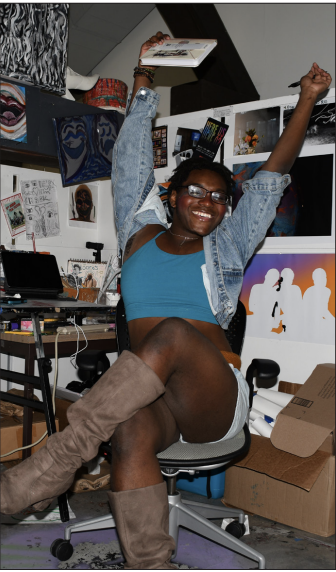
Throughout his time at Denison, there haven’t been many art mediums Mark Moore ‘26 hasn’t explored.
As an artist, Moore said he is always trying to evolve and to get to know himself better, which means “dabbling into different areas of art” to see what’s out there.
“I think I’ve always been someone who has loved creating, whether that’s something like video, or something tangible and concrete,” Moore said.
Before becoming a BFA major, he did some academic exploring as well. He initially was a math major at Denison before switching to the BFA. Since switching majors, he’s enjoyed diving into art more over time.
Since this academic transition, the evolution of Moore’s art has centered around topics of identity, intersectionality, and challenging societal norms. He started his journey as an artist by focusing mainly on drawing work, but has since branched out to many other forms of art.
Much of his work relates to personal struggles he has faced as a member of the LGBTQ+ or Black community, and his art does this by featuring personas of himself in different forms.
These different forms of personification through art are depicted through his creation of physical works such as paintings or through intimate and more raw forms of art such as symbolic movement videography. He often sees himself as “the canvas,” in much of his work as an artist. His work in the makeup realm gives the best, literal example of this.
“I love the idea of exploring different mediums and combining them, and really seeing what [different forms] have to offer to the work that I’m doing,” Moore said.
His showcase is currently in the Bryant Arts Center, and features a variety of the work he’s created this year. One of the main pieces in his showcase will include a film he produced. This film, which is titled “Mark’s Mingling Metaverse,” will depict different dimensions and layers of Moore’s identity, and will include different versions of how Moore portrays himself as well as his identities’ interconnectedness with each other. He also plans to include life-size cardboard cut outs and other visual elements at his exhibition.
He hopes that his showcase will be the culmination of his work and progress as an artist at Denison, and that it can help provide insight and hopeful inspiration to the communities he’s a part of.
“The reason why I do what I do is so that I can give back to the communities [I’m a part of], and… showcase that it’s okay to be you,” Moore said.
—
Grace Vap: “Mixing emotions” through painting.
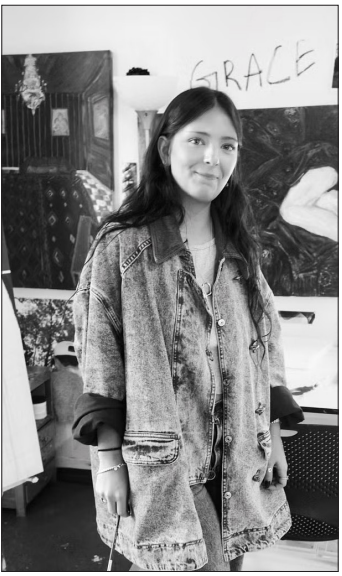
If you were to step into one of Grace Vap 26’s paintings, you’d be hit with a wave of nostalgia and unease.
These paintings, which are featured at her exhibition at the cinema house, focus on distorted perspectives and flat colors to invoke memories of childhood homes and moments that you can’t quite remember. Her work is often painted on large canvases, and mostly feature empty rooms with furniture juxtaposed at different angles with other objects. There aren’t many people depicted in her paintings.
“Putting meaning into objects is a huge thing for me,” Vap said. “If humans are present in my paintings, I really don’t want them to be the main focus. Oftentimes, I make them purposely way too small, just to amp up the idea that this person is here, and they’re important, of course, but this bed here in this room has so much more meaning.”
Although she didn’t start as a BFA major, she’s always been interested in exploring internal thoughts and feelings; Vap was originally a psychology major before switching to the BFA.
Vap’s paintings often start with her imagining spaces from her past, and then move on to focus on different elements that stand out to her. Her end goal isn’t to create a space that is beautiful, but rather spaces that “make people feel weird.”
“Some people, I feel like, don’t fully understand [my art],” Vap said. “But I like that. I don’t really need people to.”
Her art often plays with the idea behind meaning in art, and attempts to break away from typical boundaries art may exist in.
“I feel like sometimes things are too strict,” Vap said. “I think things should be a little more open in my mind than how they are.”
Still, much of her work is derived from her own past, and rooms she paints often reflect something she may have felt during her childhood. In many instances, these feelings ebb and flow between comfort and discomfort, as she attempts to “pull between two feelings.”
Her exhibit, and whatever feeling it may invoke for the viewer, will blend reality in ways one may not expect.
“Mixing things that are real and things that are imagined is really interesting to me,” Vap said. “Painting all of these ideas, and then putting it in the same place, and being like, ‘Boom! What is this place?’ is my process.”
—
Mel Wienandt: Smashed. Constructed. More color? Rebuilt. Gone again.
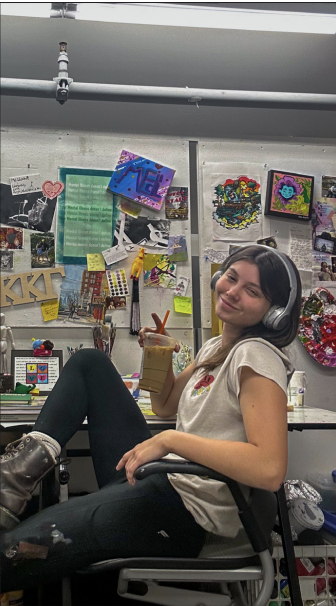
For Mel Wienandt ‘26, all of the pieces she created for her upcoming exhibition have probably undergone some level of destruction or zombification.
They’re untraditional works and break the norm; their vivid use of colors and bizarre formations immediately catch the eye. Wienandt says that her work fits into an “ambiguous kind of territory,” to show that her “experiences are my own, and that no one is able to fully understand them to an extent.”
She calls these pieces “Complex Canvas Constructions,” and the “ephemerality,” or short-lived nature, of her work is very intentional. Her exhibition, which will be held in the Bryant Arts Center on April 16, will also display photos of each piece throughout their fluid lifetime.
These pieces are often made out of wood, and range widely in sizes. Some of them are reminiscent of traditional paintings with 3D aspects, and others are similar to sculptures.
Many of these pieces represent some facet of mental health, and their constant cycle of construction and destruction represent “therapeutic engagement” according to Wienandt.
“Many artists have dealt with mental illness in different ways and use art as a way to heal, but they haven’t been as explicit with it in their process,” Wienandt said.
Still, the explicit themes behind each piece are less recognizable. An onlooker might not know that the white color in one of her canvas constructions represents clinical settings unless they had some prior information from Wienandt. This level of undefinedness is another aspect Wienandt hopes to achieve.
“Something that I found last year was that mental health is so intangible,” Wienandt said. “There’s no way to explicitly make that clear, because everyone’s experiences are so unique to themselves, unless you play on extreme cliches.”
These cliches are something that Wienandt is hoping to avoid. She doesn’t want her work to be seen as a “pity party” or something that makes people feel bad for her.
“That’s why the colors and whatnot of my work isn’t just like, ‘let me just be sad,’ and ‘look how terrible my life is,’” Wienandt said. “A lot of my work is breaking down that stigma.”
Her work also attempts to connect larger societal issues regarding mental health. One of her pieces, entitled “trauma isn’t a trend,” is a recreated image of an internet trend which encouraged users to put candy into a bowl for each traumatic event they could list off.
“Mental health shouldn’t be something that’s exploited or used as a spectacle for entertainment, rather than giving it a space to be learned from,” Wienandt said. “So even though it’s about my own experience, it also goes out from that small spot then expands outward.”
Even though her exhibit might not seem to make much sense on the surface level, Wienandt this will push viewers to think more about the process behind the work.
“I want it to be an extremely confusing looking kind of thing,” Wienandt said. “You look at it and you’re like, ‘What the [heck] is this?’ and that hopefully intrigues someone to understand a bit more of the process behind it and why it was made in that context. It’s supposed to push the idea of interpretation, just provoke a bit of curiosity to understand why it was made, while also creating a space where dialog around mental health can be shared.”
—
Amy Nguyen: The art of storytelling through writing and art.
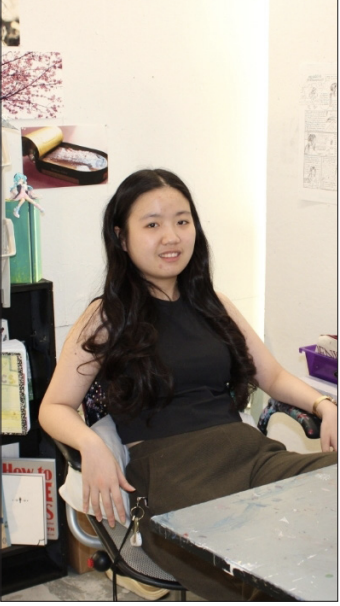
Amy Nguyen ‘26 is a comic writer and artist. But not in the way you might expect.
Her panels aren’t filled with superheroes or comedic gags. Instead, they delve into the world of nonfiction and personal anecdotes.
Each drawing represents a down-to-earth view of her background and surrounding communities, and she encourages those who indulge to treat it like a “playground for everyone to view and connect with.”
“My goal with my comics is to have this very specific and personal [feeling]…yet they can still convey this sense of connection to people who read my stuff from my communities,” Nguyen said.
Originally from Vietnam, many of Nguyen’s comics center around her experiences growing up and being an international student. Her physical work is often done in black and white, and each panel is written in a signature swirling cursive style which is written in English to account for audiences at Denison.
Much of her work also discusses personal fear people similar to her may experience, and she hopes that by reading her comics, readers will be able to feel like their concerns aren’t only felt by themselves.
“I think with fear people try not to say it out loud, because they think it’s such a vulnerable [thing],” Nguyen said. “Sometimes, you feel like your fear is insignificant compared to others. But I don’t want my comics to be that way. I want people who think their fear is insignificant, to still find that there are other people who have [similar experiences].”
Although she didn’t originally know she wanted to pursue a BFA major, she said that she came to Denison knowing that she wanted to work as a storyteller in some capacity. She dabbled a bit with animation as well, but has stuck with making comics as her main art form. In addition to drawing and writing hundreds of pages of comics, she also interned at the Billy Ireland Cartoon Library & Museum in Columbus last summer.
Her BFA senior exhibition will be on April 16 at the Mulberry Cinema House, and will feature four comics as well as different displays of comics “in the works” in the form of sketches or storyboards which show the different parts of her comic creation.
“So with [the exhibition] you’ll actually get to see the in-progress stages, not just the final work,” Nguyen said. “I’m excited for people to see the whole layout.”