
Molly Tomczyk, Special to The Denisonian
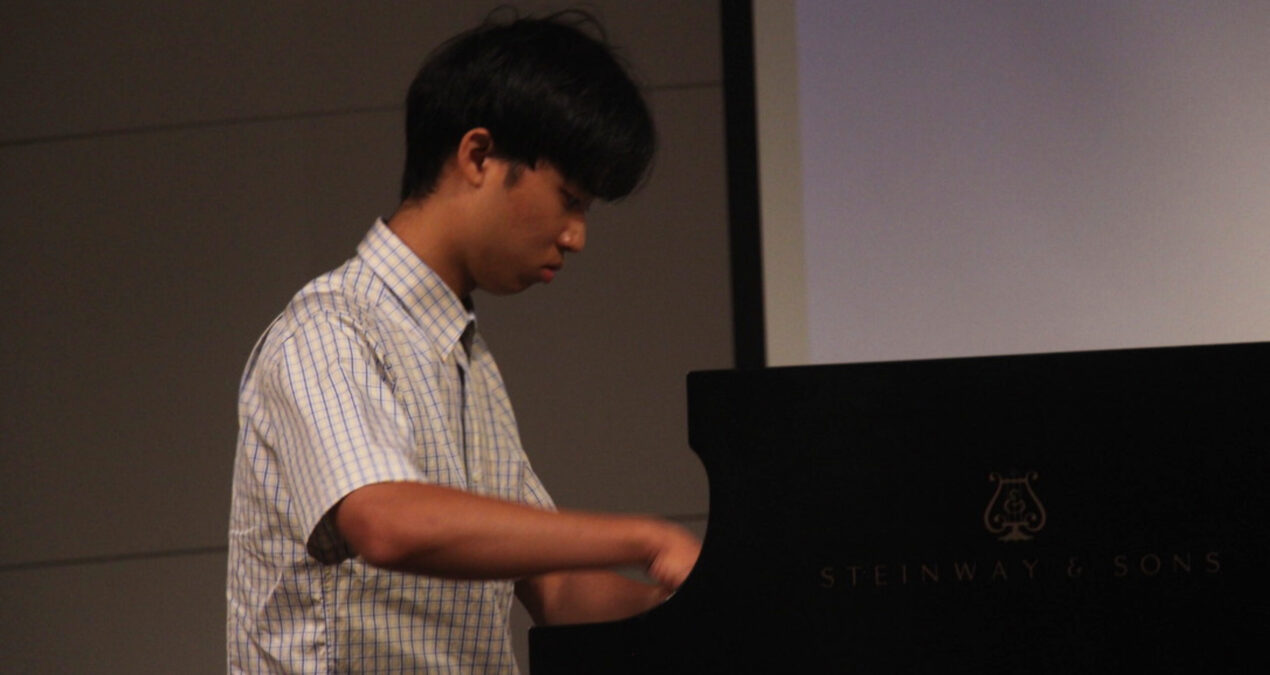
A confession finally spoken; a cascade of piano notes gushing into the audience; a representation of self mapped out on canvas. These are just a few of the creations that were showcased Sept. 17 during the Summer Scholars Creative Writing and Fine Arts Symposium in Burke Recital Hall.
During this event, students who attended an immersive research program facilitated by the Lisska Center for Intellectual Engagement, the Summer Scholars Research Program, were spotlighted. They each were allowed five minutes to convey what they had spent weeks working on, Dr. Diana Mafe, Director of the Lisska Center for Intellectual Engagement and English professor, said.
“The motivation for many researchers, students and faculty, is to share what you’ve learned, to share knowledge, to invite feedback [and] to start conversation,” Mafe said. “Summer Scholars [Research Program] models that by inviting the students to not just do the research, but then share it, present it [and] talk about it.”
Students get to decide their topic of research for the Summer Scholars Research program, and it does not have to be within their major, Mafe said. Proposals for students’ ideas must be submitted by Feb. 1 to be considered for either a five or 10-week program. If selected by an elected faculty committee, the student dives into the topic over the summer with the guidance of a faculty mentor. The program provides an opportunity for students to give their undivided attention to this area of interest, Mafe said.
“This is a project that a student has invested in, often they’ve visioned it from the ground up, and they’ve been able to bring it to fruition,” Mafe said. “It gives them a sense of accomplishment.”
The artists, performers, and writers present were a fraction of the whole group of summer scholars. The majority, some involved in the Anderson Summer Science Program and some a part of the Lisska Summer Scholars Program, presented their research in a poster format on Sept. 10. The separate symposium format allows non-fine-arts scholars to present their work one day while making time for fine arts projects to be shared on stage another day.
“The goal is to give our students an opportunity to present their summer research to as wide an audience as possible,” Mafe said.
Among the presenters on stage was Cailyn Skiles ‘29. From May 18 to June 19, Skiles devoted her summer to crafting six self portraits, each reflecting a different stage in her life, and each made with a different type of medium.
“The goal of my project was to examine how different media can carry different emotional weight in portraiture and experiment with how I would represent myself in different media,” Skiles said.
For example, in Skiles’ portrait of herself as a baby, she painted with watercolor. For her second piece, Skiles utilized chalk and colored pencils to represent her toddler self, she said.
“I was talking with my mom and asking her about how I was at that age, and she said once I knew how to walk, I started running, and I was hard to keep tied down,” Skiles said. “That’s how chalk feels. It gets everywhere when you work with it.”
Skiles’ process typically began with a photograph. Scrolling through camera rolls, Skiles pinpointed eye-catching photos, she said. For this project, she looked for photos that stirred up a memory or encapsulated a version of herself.
One of the more difficult ages to dive into was Skiles’ portrait of herself in high school as the COVID-19 pandemic concluded, she said. Skiles harnessed charcoal to portray a black-and-white image of long hair hanging down and past the border of the portrait, with a mask covering the bottom half of her face. Skiles said the charcoal elicited the same emotions she felt at that age.
“That piece takes me back to freshman year of high school and how lonely that time felt and how isolating it was to be starting high school after a whole year of not being around other people,” Skiles said. “It was uncomfortable to work with; but it made me feel for her, viewing my younger self as another entity. Like, I feel for you, girl, and things are gonna be okay.”
When she was not in the Bryant Arts Center studios creating, Skiles stayed in the senior apartments. Scholars received housing for the duration of their stay as well as a $2,500 stipend for the five-week program or $5,000 for the 10-week program, Mafe said. Overall, summer scholars gained research experience and had a chance to explore something they’re interested in, Mafe said.
“[The Summer Scholars Research program is] an opportunity to do groundbreaking innovative research without having to worry about grades [or] credit,” Mafe said. “Students can see the joy and value of investigating something for intellectual inquiry.”
Skiles is considering majoring or minoring in visual arts and moving forward with this passion in the future, even though she has her doubts.
“It’s scary to want to commit to visual arts because there’s the notion of [a] starving artist or not being able to find a job in the creative field,” Skiles said. “But honestly, it’s hard to find a job in any field in this day and age, so I’d rather do something that makes me happy. [Art is] just something I keep coming back to.”