
Zoe Ward, Staff Writer
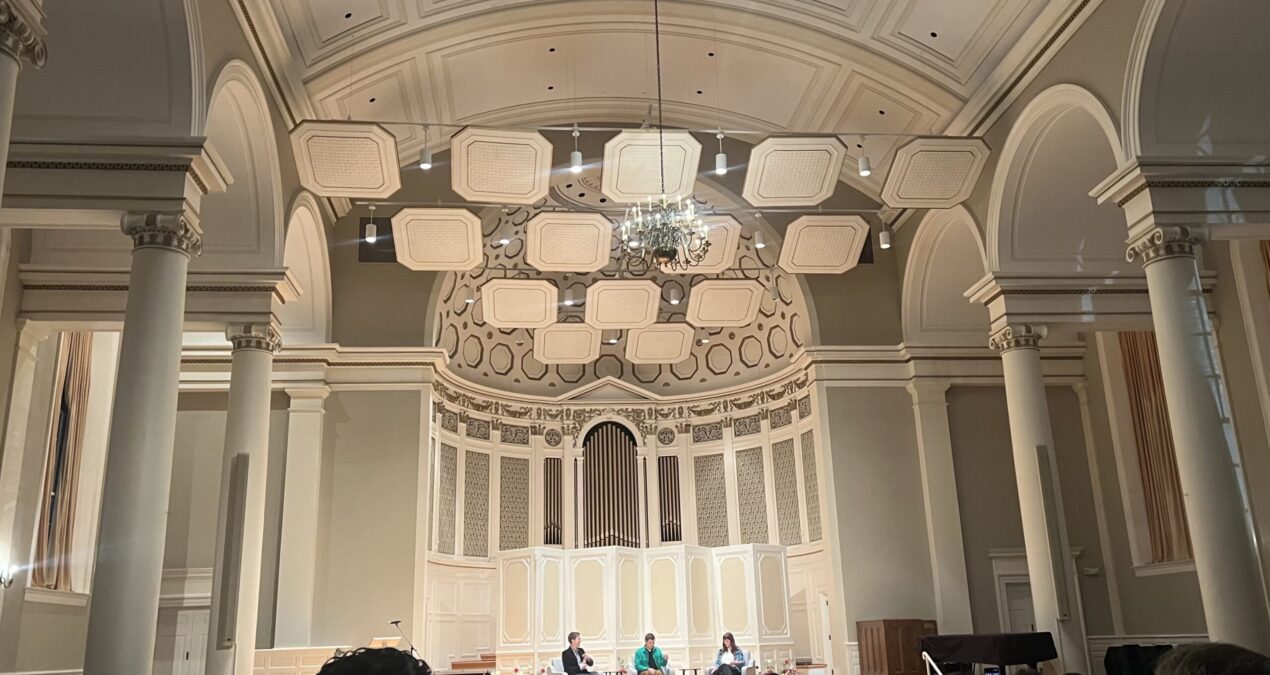
More than 100 students, professors, and community members gathered in Swasey Chapel on Nov. 6 to hear poet Maggie Smith and novelists Kevin Wilson and Emily St. John Mandel in conversation. The discussion was the final and highly anticipated event of the inaugural Beck Literary Festival, which brought several acclaimed literary creatives to Denison. Coinciding with Big Red Weekend, the authors’ voices echoed underneath the arched ceilings, red-and-white flowers decorating the stage.
Kevin Wilson is Denison’s Nan Nowik Writer-in-Residence for the 2026-2027 academic year. He led a week-long fiction workshop for interested students. Maggie Smith, who moderated the conversation, is the next Writer-in-Residence and will host poetry workshops during the 2027-2028 academic year. Smith highlighted the “unexpected connections” between the authors’ latest novels, Wilson’s “Run for the Hills” and Mandel’s “Exit Party.” Smith identified a shared interest in the “counterlife,” the alternate lives people might have led had their circumstances or choices been different. Mandel responded excitedly, explaining that she had begun writing “Exit Party” in 2022, at a time when the “country felt incredibly fractured.”
“I’d written about the counterlife of the individual, but what about the counterlife of the state?” she said. Wilson’s newest novel, “Run For the Hills,” explores this theme explicitly as well; the novel examines the consequences of Charles’s repeated reinventions, as he abandons one family after another to begin a new life.
Narrated by Charles’s children, “Run For the Hills” maintains moments of levity through the siblings’ playful interactions and eccentric road trip. Smith commented on Wilson and Mandel’s balancing acts, asking how they successfully “strike balance between light and dark…funny and heartbreaking” in their work.
Wilson explained that he prioritizes “lightness” early in his novels, using humor to earn readers’ trust that he can return to it after darker moments. Mandel agreed, commenting that, as humans, “we always reach for some degree of lightness.”
Wilson gestured to the audience, stating, “Isn’t it some kind of relief to know that we all have some shared providence of pain?” He emphasized that reading is important “to understand that [you’re] not alone in that darkness.”
The authors shared a glimpse at their writing processes, finding common ground in their pursuit of the “weird.” Wilson remarked, “The longer I keep an idea in my head, the weirder it gets.”
Smith laughed, sharing that she keeps a Post-it note on her writing desk that reads, “Make it weirder.”
Wilson further explained the nature of his “repetitious brain,” and how “when you consider something for the hundredth time, it’s a mutation;” he enjoys thinking about topics in depth so that once he begins to write it out, it contains every version he’s thought through.
Wilson added that he wrote his bestselling novel “Nothing to See Here” in just ten days because he had been thinking over the idea for so long. Mandel explained that she does not outline her novels because she “wants it to be weird.” She expounded, “If I don’t know what the book is when I start writing,” there’s a “real possibility of a surprise.”
The novelists addressed the dreaded process of revision. Wilson articulated that each time he “hit resistance” in a writing session, he goes back to the very beginning of the novel and starts over. He expressed that making small changes to his work, and thus revisiting all of its positive elements, can “remind [you] that it is good.”
Mandel declared that she revises “in an intensive, obsessive way over a long period of time.” She contended that “as artists, we should be working at the very outer limits of our ability” at all times. This obsessive striving for greatness is evident in both Mandel’s and Wilson’s works, as they continue to sell hundreds of thousands of books and push the boundaries of fiction.