
Nora O’ Byrne, Staff Writer–
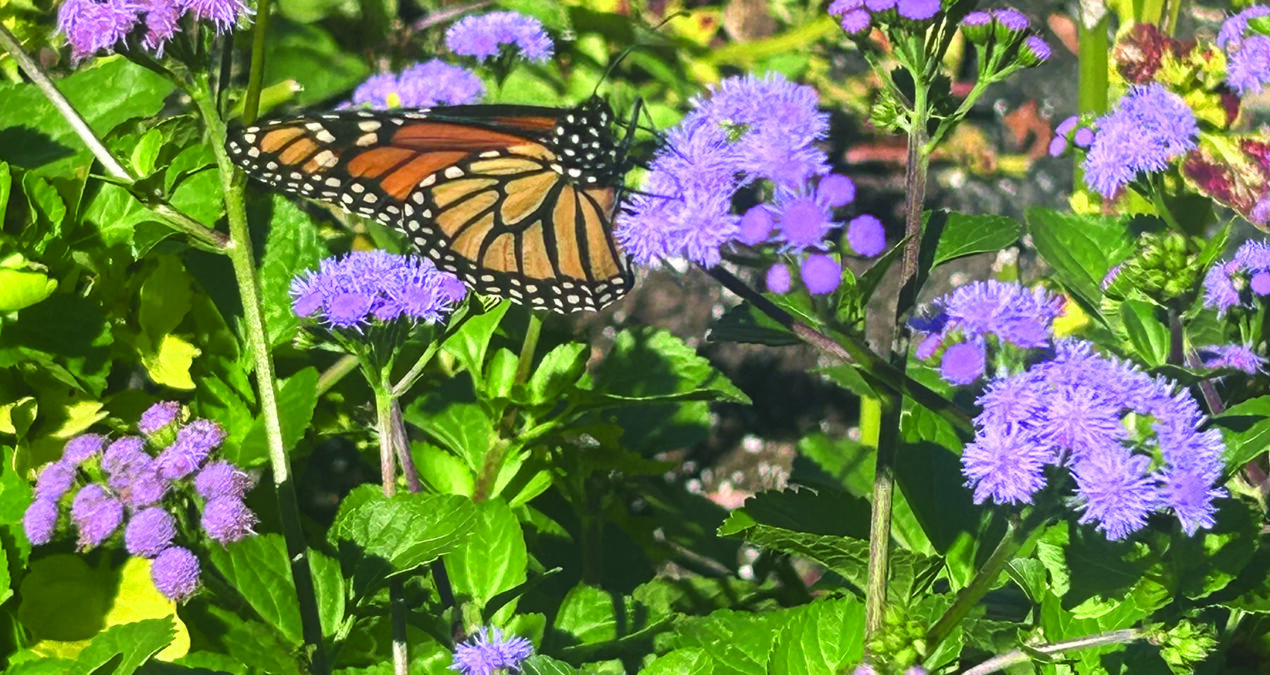
If you walk down the path between Olin and Herrick Halls, you’ll probably be met with a swarm of butterflies to the face.
West Quad residents have become familiar with the butterfly-attracting flowers behind Herrick Hall. The moment the sun comes out, dozens of monarchs flutter across the path.
For many students, the butterflies are a token of joy in an otherwise hectic time of year.
“It puts a pep in my step,” said Isabella Rivera ‘28. “It’s awesome to see more native species around campus.”
Ann Cherry, the senior groundskeeper, said that the flowers were planted with the intention of attracting butterflies.
“Up in that garden is lavender,” said Cherry, motioning toward the plants. “Pollinators love that. The blue taller flower is black and blue salvia. That is a pollinator flower all the way.”
Starting this year, the groundskeeping team has planted Ageratum Monarch Magic. As the name suggests, the plant is especially attractive to monarch butterflies.
“[Ageratum Monarch Magic] was brand new,” said Cherry. “I was laughing like, ‘Oh, sure.’ And it’s very remarkable!”
Cherry acknowledged that the university has been working especially hard to protect pollinator spaces on campus.
“We have cone flowers, we have bee balm. We’ve brought in lots of perennials to help [pollinators] along, too, because if you don’t have your pollination, you’re not going to have anything. So, we got to do our help.”
While the blooming pollinator spaces on West Quad thrive, others have quietly disappeared. Just last year, the hillside leading down toward the Mitchell Center was decorated with colorful zinnias. Now, the field is back to grass.
“We did get a new grounds manager, and he started in January, and so he wants to bring all that back. It’s just overwhelming. It’s a large campus. He had to come in and just learn it. So, we really scaled down.”
Cherry reassured that the flowered hillsides will be returning to campus in the future.
“We only had zinnias, and over at Silverstein, and we didn’t do a lot of the wildflower hills. We did have poppies in the spring. So that will be coming back. Maybe not in that area, but it will be coming back.”
Dr. Susan Villarreal, an insect behaviorist in Denison’s biology department, believes that the spaces are a valuable resource for visiting insects.
“They fly long distances,” explained Villarreal. “Insects are coming from Denison, all across town. It gives them a place amongst all of this human space where they can actually rest.”
Villarreal approaches biology through the lens of thinking about why animals behave the way they do. In terms of butterflies, she explained that their behavior is shaped by a mutual relationship between plant and pollinator.
“If the insect can really get to know and understand the anatomy of the plant, then it can more efficiently go in there and get what it needs,” said Villarreal.
Beautification efforts on campus inevitably affect natural ecosystems. For the butterflies, the flowers on West Quad are one of few vital food sources available.
“We live in a fragmented habitat. As you start putting humans into natural spaces, you’re just going to augment those natural spaces,” said Villarreal. “Now what happens is you have these clusters of flowers that the insects are relying on for their food throughout the year.”
Considering the insect is step No. 1. When creating pollinator spaces, every little detail matters.
“Different types of flowers. Different colors of flowers. Different heights of flowers. Different times of the year in which the flowers are flowering. They’re all important to consider,” said Villarreal.
While there isn’t an established relationship between the grounds team and the biology department, Villarreal acknowledges their efforts in conserving pollinator spaces.
“As a biologist, what we want to see is steady, reliable, yearly populations of diverse habitats where lots of pollinators could live and thrive. I think a lot of people in the grounds [team] keep that aim in mind as well.”
Dr. Villarreal used to take her animal behavior class to the hillside leading down to Mitchell.
“It was all just one flower, and now it’s just grass. I have to keep being adaptable, and for my classes, be like, ‘OK, where can I actually take my students on campus to get pollinator plants that… could be interesting to answer questions about.’”
Pollinator spaces are more than something pretty to look at. To Villarreal, being aware of insect contribution is step number one.
“Insects have a really important role. They’re found everywhere except the middle of the ocean, and they are food for a lot of things. They help stabilize food webs. So, it’s great that more people are starting to pay more attention to them.”