
Ella Kitchens, Features Editor–
The next three semesters will be the last time that students can live at the Homestead, a living-learning community at Denison focused on sustainability. The current residential form of the Homestead, will be shut down in 2027 as part of a “sunsetting” process that has been in the works for several years.
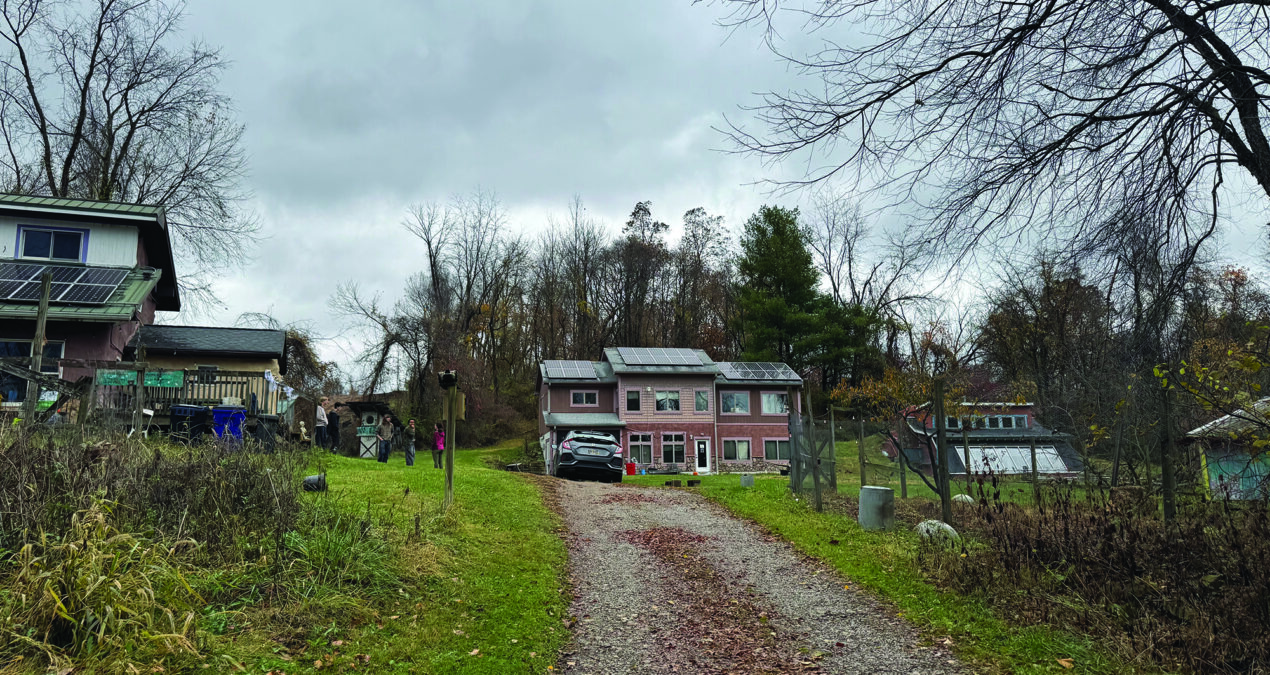
A 20-minute walk from Denison’s campus, the Homestead was founded in 1977 and can house 12 students. Students living at the Homestead participate in all the chores and upkeep required to keep the community running. This includes feeding the chickens, cooking dinner on a wood-burning stove, and maintaining a compostable toilet and wood-fire heating system.
The decision to close the Homestead as a residential option came from both the administration and the division of student life. This decision was made for a variety of reasons, including low engagement, institutional changes, and focus on community on the Hill.
“There’s a general sense among lots of folks who’ve been involved with the Homestead that in its current form it’s been great, but it’s time to celebrate it and figure out what the next evolution looks like,” said Denison President Adam Weinberg. “And a decision that whatever that next evolution is, it should continue the history of the Homestead, but in a new form.”
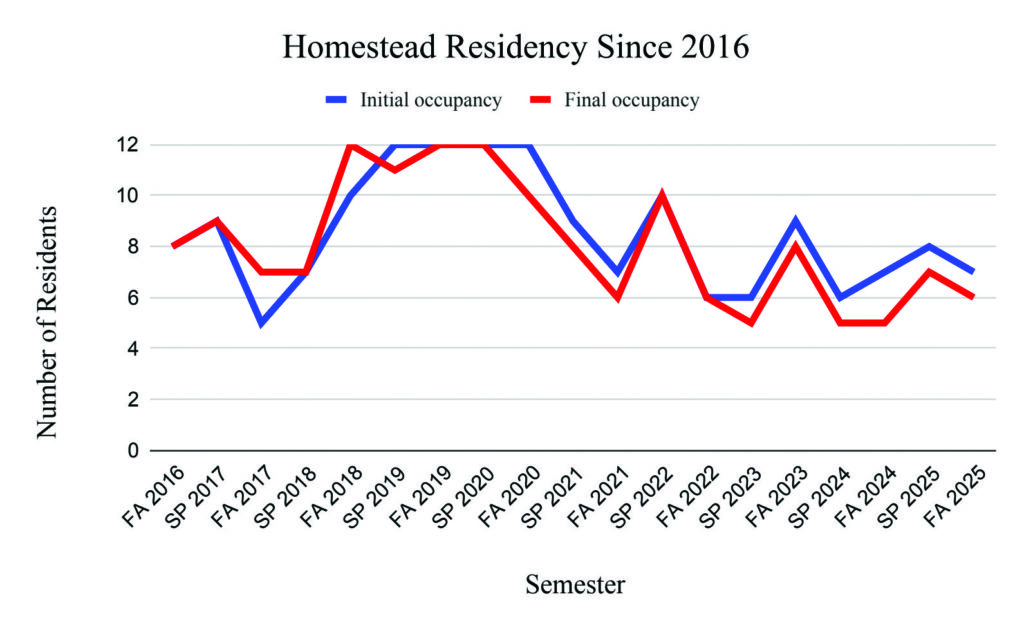
This semester, there are six students living at the Homestead. There has not been a full house of 12 students living at the Homestead since 2020.
“There’s currently only six students living there. That’s hard to run a whole community,” said Dr. Nicole Ausmer, senior associate vice president of student life. “That’s just not enough students to do what it originally was intended to do.”
However, students living at the Homestead say that fluxes in interest have been common throughout the Homestead’s nearly 50-year history.
Graph by Ella Kitchens / The Denisonian
“Talking to alumni, people who have been involved a lot longer, it seems that there’s sort of an ebb and flow to the homestead that I think the administration’s ignored a little bit,” said Jakob Loche ‘27, a current Homestead resident. “Apparently around the ‘90s, 2000s it was that same case [as now]. Every few years it goes in and out of fashion to live in a place like this.”
Residents have hoped that the decision to close the Homestead will be reversed with higher engagement. They are in the process of taking applications for students to live there, with 12 students expected to apply for the spring of 2026.
Although they cannot live at the Homestead until they are sophomores, first-year students in particular have been engaged with the Homestead community this year.
“A big group of freshmen have really shown interest in [the Homestead] this year,” said Christine Keough, ‘29. “I heard from a friend about their community dinners. Everyone was so welcoming, it just felt like we fit in right away.”
Despite high engagement through community dinners and recruitment this semester, the decision will not be reversed. However, Ausmer encourages students to still take the opportunity to live at the Homestead while they are able to.
“My hope is that for the next three semesters, we hit that [maximum number] every time,” Ausmer said. “I want them to soak up this wonderful opportunity that they have to be down there… I want students to realize the moment that they’re in and meet it by saying yes to the opportunities that are right in front of them right now.”
As she oversees the residential communities and housing office, Ausmer has become the “point person” for this project. She has looked into the “why” behind Homestead engagement, including what many see as a recent lack of engagement.
“I think most students compare their lived experience,” said Ausmer. “If you say, ‘do you want to live at Silverstein or do you want to live at the Homestead?’ Many students are picking Silverstein. Not even just the modern luxuries, but the proximity to campus, the closeness. So we have a student population that enjoys the convenience of many things that are up on The Hill versus being off campus.”
Institutional changes have also led to incompatibility between Denison and the Homestead in its current form. Some residents had traditionally stayed at the Homestead over the summer without official permission from Denison, but this changed due to institutional risk.
“From an institutional standpoint, it’s not great to just have people living on campus without knowing who those people are and what they’re doing,” said Dr. Tom Henshaw, visiting assistant professor of sustainability and environmental studies and global health. Henshaw was Homestead coordinator from 2010 to 2016. He is currently teaching the Homestead seminar and has been on the Homestead Advisory Board since 2018.
Due to this institutional risk, “they constrained the Homestead to being a residence for individuals who have on-campus employment or internships within the region the same way that any other residence hall is available during the summer,” said Henshaw.
This change led to a decrease in summer residents, which led to a lack of tending to the garden and other important tasks.
Another institutional change was the addition of Homestead residents to the Denison housing and meal plan. Previously, Homestead residents had an exemption to the housing and meal plan, which led to more flexibility.
“Now it’s about swipes, Flex Dollars, instead of like, putting $100 each in this jar, and we’re gonna buy groceries from here,” said Henshaw. “I never really felt it being cheaper was the reason people move there. But I do think it’s changed the expectations of what the university versus what the homestead provides.”
There have also been concerns about the Homestead’s independence from the greater Denison community.
“Because it’s such a great piece of property, the idea is rather than a handful of students really benefiting from what we’re doing out there, how do we do something that really benefits a lot more students?” said Weinberg.
The Homestead is off campus at a fully residential college, which leads to another concern.
“The thing that I love about the Homestead is it gives a small group of students a chance to live together, to self-govern, and to do things they want to do… But I think the downside for a lot of students is it’s really far from campus and you feel isolated,” said Weinberg.
Many students living at the Homestead are not happy with the administration’s decision.
“We have people who come every single Friday, and people who will come over and stay for a few nights, too,” said Emily Lessard, ‘28, a student living at the Homestead. “I think it’s a disservice to people who are applying in the future to shut it down and deny people this opportunity because it’s a big thing that makes Denison unique.”
“Denison is worried about student retention during your first year and finding community,” said Lily Meyer ‘28, another Homestead resident. “But they’re not really investing in what we already have. Emily and I thought about transferring during our first year, because we didn’t feel like we had a place on campus, we didn’t feel like we had a lot of community. And the Homestead is the reason we’re both still here.”
“My decision to apply to the Homestead is the best decision I’ve made at Denison, period,” said Noa Holland, ‘27. “More than my major, more than my friend groups, the Homestead genuinely saved my academic experience. And I can’t promise that I’d still be at this school if I didn’t apply to the Homestead.”
Henshaw said that the decision to close the Homestead provoked pushback, and also conversations with both students and alumni about the Homestead’s importance.
“I don’t think anybody, when there’s radical change in terms of any structure, is like ‘yay,’” said Henshaw. “There has been pushback, but there’s also been some really good, thoughtful, pragmatic conversations about what does that mean? What was it? What is it? What could it be? What is it like? What was important about it?”
While the plan to close the Homestead is final, what will happen to this space yet is still undecided. Weinberg, Ausmer, and Henshaw all emphasize that Denison plans to involve both current students and alumni in this discussion.
“The two [ideas] that I’ve heard… are both interesting,” said Weinberg. “One is an alum talked about if we could do some sort of large community farm out there… The other idea I’ve heard is could we do something out at the Homestead where students or classes could potentially go out for a weekend or a few days for some sort of experiential project.”
Weinberg also hopes that the Homestead’s sense of community and self-governance will continue on campus. An idea that has recently emerged is building houses for students on the Hill.
“We’re in a really early phase of trying to listen to students,” Weinberg said. “If we could bring some of the best of the homestead closer to campus and we had a community of communities… that could be really good for the campus. We’re always trying to just listen to students. What’s working, what’s not working. Given that we have a finite amount of buildings and land, how do we use that best to meet the needs of as many students as we possibly can?”
Max
Just heartbreaking. The Homestead is the most welcoming and uniquely special place at Denison. This article speaks a lot about wanting to listen and be in conversation with students, but that hardly feels sincere, given that the decision to shutter the place so many of us love was made without any such conversation.
Don Miller
During my junior year, In the fall of 1976 I read an article in the Denisonian by biology professor Dr. Bob Alrutz proposing the idea of the Homestead. I went on to design an independent major focused on helping build the first structures and living my senior year there. I am glad that the Denisonian has continued to inform the campus of events concerning the Homestead. I am now part of a large group of alumni concerned about its future. We are grateful to have had the chance to live there and hope that other students will have that opportunity. I am encouraged by the enthusiasm of the current residents and hope that the administration seeks input from them and alumni to chart the best path forward for this unique educational opportunity.
David Lovett
Disappointing. There is still time for the Denison institution to change its mind. It sounds like the agency and autonomy of the Homestead has slowly been drained over the years. I’m heartened to hear the current students aren’t going to let it go down without a fight. And it’s nice seeing the upswell of Homestead alumni coming together to support the current students and our former home.