
Donald Keough, Editor-in-Chief
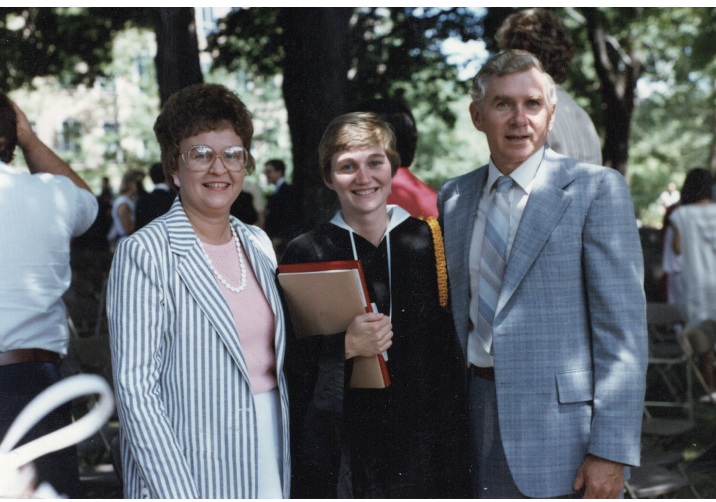
In 1981, Kim Coplin ‘85 walked into the Denison University admissions office as a prospective student. She was planning to stay for two years before transferring to a pharmacy or engineering program.
Today, she works in that exact same building as the university’s provost.
“It will be the first building I walked into, and the last building I will be part of,” Coplin said.
Coplin didn’t have plans to attend a liberal arts college. But during her senior year of high school, she received a scholarship funded by a local judge’s family that covered two years of tuition, as long as she went to a liberal arts institution.
After touring the campus, she decided to enroll at Denison.
“I started off as a chemistry major, ended up taking physics my sophomore year, and absolutely loved physics,” Coplin said. “I had a great group of professors and ended up majoring in physics.”
Her time as a student was similar to students’ experiences today. She wasn’t involved in the dominant fraternity and sorority life of the 1980s, but she found her community elsewhere. She played bassoon in the concert band, served as a teaching assistant for science labs, and met her husband, Rick Coplin ‘85, while they both served on the chapel advisory board.
She also recalls studying with her biology major roommate on the fourth floor of Higley Hall in the anatomy lab.
“We would study there because nobody else would study there, because it’s where they dissected animals,” Coplin said.
After graduating in 1985, Coplin went on to a PhD program at Johns Hopkins University. After her first semester, she said that she missed the variety of classes she had taken at Denison, like theology with Dave Woodyard ‘54 or Black history with Jack Kirby.
She then took a year off from her graduate studies to work at Battelle, a research organization in Columbus. After her job there, she said she decided she wanted to pursue a career in academia.
“I knew then that I wanted to teach at a place like Denison,” Coplin said. “I wanted to pursue a research program that I could take back in some form to a liberal arts college.”
She transferred to Ohio State University to finish her PhD in condensed matter physics, focusing on conducting polymers.
The same year she finished her doctorate, Denison began hiring for a series of physics department retirements. She was hired in 1993, returning to the same department where she had once been a student.
The professors who had once taught her became her colleagues and mentors. Her current office holds memorabilia from these colleagues, such as a rubber grading stamp from professor emeritus Rod Grant, that marks flawed assignments. It bluntly reads, “bullshit.”
During her 13 years as a physics professor, Coplin loved working with students. She would take her classes to her house for experiments, and helped spearhead research projects that didn’t always apply to her field of research. One such project she helped organize was a biomechanics experiment Melanie Lott ’04 conducted that looked at the physics behind movements such as pole vaults or ballet leaps. Today, Lott is a current associate professor in the physics department.
In 2006, Coplin said that she was asked to bring a faculty perspective to the administration by serving a three-year rotation as an associate provost.
Three years turned into six, and by 2013, during President Adam Weinberg’s transition, she was asked to stay on as interim provost. She was eventually named as the chief academic officer, overseeing faculty hiring, reviews, and academics at Denison.
Despite her major role in shaping the university, Coplin acknowledges that many students may not understand what her job means. She recalled a video made by a former provost at Wake Forest University who walked around campus asking random students if they knew what an academic provost did.
“They’re like, ‘No, we have no idea. Are you in charge of the college cemetery? Is that what the provost does?’” Coplin said. “Anybody who’s provost realizes students have no idea what you do.”
As provost, her office handles almost everything related to academics at Denison, including building new academic programs or restructuring others.
A major part of her work as provost has involved expanding Denison’s academic offerings. Before 2013, the last new academic major the college had introduced was Environmental Studies, which was established in 1993. Since her employment, several new, forward-looking programs, including global commerce, data analytics, finance, health, exercise, and sport studies and journalism, have been founded.
Unfortunately, as provost, she has less interaction with students than she did as a professor.
While she admitted she initially experienced “homesickness” for the classroom and her students, she has found her current role rewarding.
Her extensive tenure is coming to an end this summer, as Coplin is retiring and Alisa Rosenthal will be taking on the role starting in July. Looking back, she enjoyed seeing the progress the university has made, and what values it’s stayed consistent to.
“What is consistent to me is still the overall concern for the student and the student’s success, both while they’re at Denison and after they leave the college,” Coplin said.
She is also pleased with the hiring and departmental changes her and her office have made.
“One of the things I’m most proud of as provost is we’ve done a lot of faculty hiring,” Coplin said. “I think we have continued to hire faculty who are committed to students and to the core of what Denison is all about, the exact same way that the professors I had were when I was a student. That makes me very, very proud.”