
Cash Lahey, Special to The Denisonian
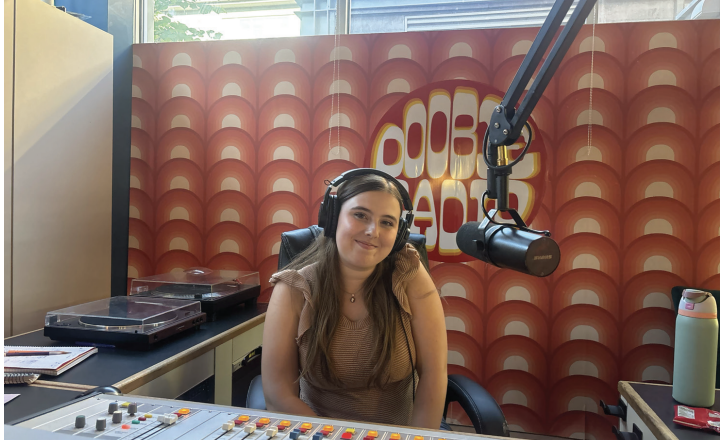
Doobie Radio, Denison University’s student-run online station, has implemented new restrictions after receiving legal warnings in the spring of 2025, prompting changes that have reshaped how student DJs plan and broadcast their shows.
Last spring, the radio station managers were notified that they did not have a contract with the company SoundExchange, which collects and distributes royalties to musical artists. According to Natalie Casa, the station’s program coordinator, the Doobie was not formally sued but faced potential legal consequences.
“It was more of a warning,” Casa said. “Which we were, again, lucky to get from the legal fellow.”
A few years ago, the Doobie transitioned from a traditional radio to an online streaming platform. Casa explained that licensing requirements related to streaming had not been fully addressed or considered during that shift.
“Technically, we should have been paying them since we went online,” she said. “I’m honestly surprised it hadn’t been a conversation years ago.”
Under the new rules, DJs may not play more than four songs by the same artist within a three-hour span of time, or more than three songs from the same album during that time. For two-hour shows, DJs are limited to two songs per artist. They are also not permitted to announce times that specific songs will air.
“You can say, you know, ‘I’ll be playing a Taylor Swift-themed show,’ or something like that. But you can’t be like, ‘I’m playing “Love Story” at 12:30 p.m.,’” Casa said, “It can’t be an on demand service like Spotify. It has to be spontaneous. That’s what makes radio radio.”
In addition, DJs must check each track individually through a licensing database before being played. Those databases are Broadcast Music Inc. (BMI), American Society of Composers Authors and Publishers (ASCAP), Global Music Rights (GMR) and Society of European Stage Authors and Composers (SESAC). Navigating the databases can be complicated according to Casa.
“I’ll look up a song and it looks like it’s the right song, but the songwriters are different,” she said. “If people make mistakes, that’s totally fine.”
Station managers seem to understand the transition may not be perfect. For some DJs, the restrictions have completely reshaped their creative liberties. Casa said she previously aired artist-themed shows featuring multiple songs from one musician.
“I really liked those artists. That’s what I wanted to listen to,” she said. “Now you’ve got to be more conscious.”
The changes may also limit the ability to play underground artists and albums that are not registered with performance rights organizations.
“It’s unfortunate,” Casa said. “Especially at a college station, you want to highlight smaller artists. But technically, if they’re not registered, we can’t.”
Erik Klemetti, a Denison professor who served as Doobie’s faculty adviser from 2017-2020, said these types of restrictions are standard practice in the radio industry.
“I understand the frustration,” Klemetti said. “However, music licensing rules tend to be very specific and do sometimes include limits to the total number of songs by specific artists. It sucks as a DJ!”
Klemetti, who has previously worked in professional and non-commercial radio, said limits on stations in general are common and a part of the learning process.
“If you want to DJ, that is the reality of the situation. Part of the skill of being a good DJ is learning how to work within those rules,” he said. “The idea is to offer variety and new sounds, especially in the non-commercial formats.”
Doobie has always required their new DJs to complete training and a written test to ensure they can handle the technical aspects of hosting a show. However, the test now also includes a section on licensing procedures. According to Casa, executive board members also occasionally listen in on shows to confirm DJs are following the rules while on air. Though the new policies prohibit some creative freedom, Casa said most DJs have adjusted.
“I know people are frustrated,” she said. “But I do think there’s an understanding at this point that it’s just what has to happen.”