
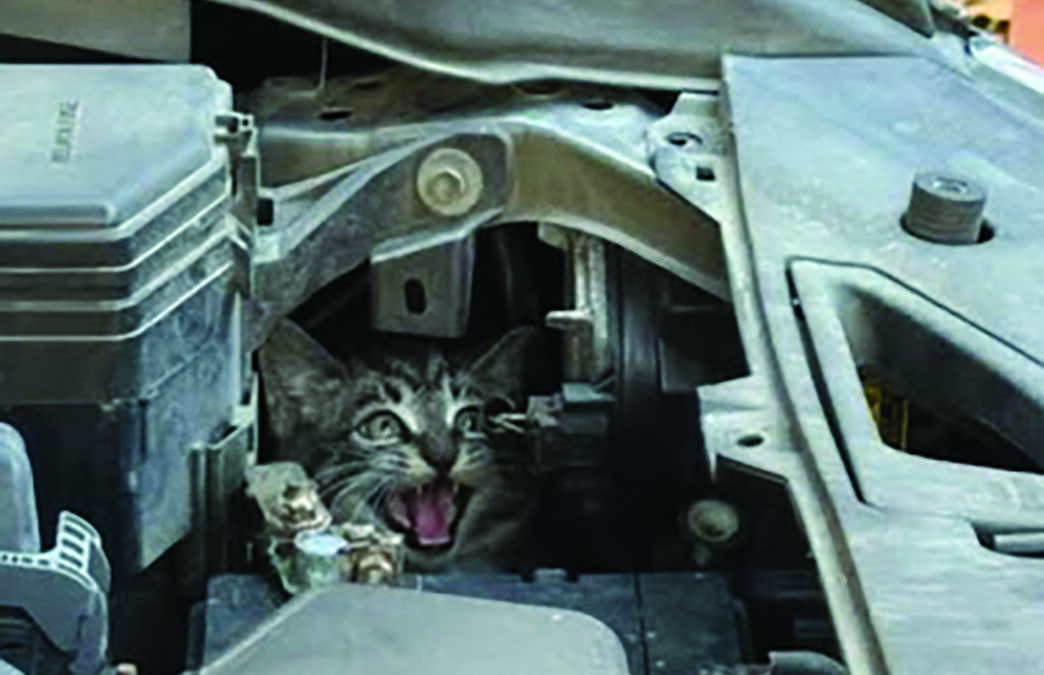
Anna Burzynski, Special to The Denisonian
“6 AM,” according to campus security officer Joseph Hegenderfer.
Caitlin McLearn ‘27, an athlete on the women’s lacrosse team, was driving down to Mitchell for her early speed and agility practice when she thought she heard a noise coming from her car, which she had rushed into that morning because of the cold temperatures outside. McLearn brushed it off as being a weird car sound, but as she kept driving, the noise got louder and was a distinctive meow. She checked in the few minutes she had before practice, but didn’t see anything.
The issue was forgotten for the hour of lifting. One of her teammates had asked for a ride home, and the two laughed about the story of the noise. However, as they drove, they heard the noise loud and clear. They pulled over to a parking lot to check it out. As they looked in the hood, a maintenance worker drove by and asked if they needed help. McLearn just responded, “I think there is a cat in there!”
“7:30 AM”
Hegenderfer, familiarly known as “Campo Joe,” was on his standard morning patrol when he noticed a campus electrician, Jordan Fox, in front of a car with its hood up and two female lacrosse players next to it. Hegenderfer assumed they needed help jumping the battery, so, with cables in the trunk of the car, he pulled into the parking lot located by the Kappa Sigma House and pickleball courts. Instead of the car being damaged, the two girls heard a cat from inside the car.
Hegenderfer had previously lived in rural Colorado and had had experience with stray cats that would climb into cars for warmth in sub zero temperatures. The group looked around and could see the cat was way down in the engine area, somewhere they couldn’t just grab it from. After working to nudge it further up in the car, Hegenderfer was able to reach down to get a hold of it. He was met with a hiss, and earned a few battle scars after being bit by the creature. When they went for round two, Fox supplied a pair of heavy duty gloves as protection.
Fox was able to pull the cat out of the hood; now discovering that it was a small kitten. Before they were able to have a firm hold on it, Fox dropped the kitten and it ran off into another car.
The new car’s owner had just celebrated their 21st birthday and woke to Hegenderfer and Fox knocking on their door to open their car’s hood. Hegenderfer seemed sympathetic to having to wake the student up, noting that they were “good about it,” when helping to open the hood. They couldn’t see the kitten hiding anywhere, even checking under the pickleball courts. Fox and Hegenderfer decided to leave, but would periodically come back to check if the kitten was visible.
“10:30, Maybe close to 11, AM”
On one of the check-ins, Fox heard the kitten meow from a car in a different row than where they originally thought it was. Hegenderfer picked the student who owned the newest suspected vehicle up after her class in an attempt to collaboratively try and catch it again. Better prepared from last time, Fox put on the gloves to reach into the engine. Right as Fox reached in, the kitten took off to the lower part of the engine, then out of the car. The animal dashed into another car in the row closest to Washington Drive.
Bested again, Fox and Hegenderfer left and through their dispatcher, Amy Ritter, were able to get in contact with John Delf, another campus security officer and retired Columbus Firefighter. Delf told Ritter about a cat rescuer named Betty Miranda.
Miranda works at ROCK, Rural Ohio Cats & Kittens. On their website they describe their mission, “We are a small all volunteer group focused on Trap, Neuter, Return (TNR) and adoptions, servicing rural cats of Knox, Franklin, and Licking counties primarily.”
“20 after 2 PM”
Miranda was given Hegenderfer’s number by Delf, and she contacted him saying that she could be at campus in roughly an hour and a half.
“I told her then, ‘I’m not sure which car it’s in. It’s somewhere in this row, but I’m not sure which one, but I’ll try to find out’,” said Hegenderfer before he revealed his method to track down the kitten.
He went on YouTube and looked up “mother cat calling her kittens.” He went through a few different options, playing the sound out loud, and walking up and down the row he suspected the kitten to be in. There was only one sound that he heard a meow, but it wasn’t in the row he had previously thought. He played the specific sound again and was able to find out which car the kitten was hiding in. Fox came back to the lot, but they decided to wait for Miranda. Hegenderfer said that she had helped catch and spay and neuter around 200 cats in her time working at ROCK.
“Around 4 PM”
Miranda arrived with a crate and her husband, who was carrying a pole with a net attached to the end. They called the student whose car the kitten had been believed to be hiding in via Hegenderfer’s echolocation technique earlier. The student was in class, but admitted the car was unlocked and they had permission to open the hood themselves. “It’s not wise to leave your car unlocked. But in this case it was good,” Hegenderfer said.
Once the hood was open, they immediately saw the kitten, who was sitting on top of the air filter. Miranda’s husband put the net over the cat and they were able to put it in the crate. The kitten didn’t go without a fight as it was angry and hissing the entire time, but it was going to the shelter to have a check-up.
“Later that night”
Later that night, Hegenderfer received a video of the kitten sent from Miranda. The video is the kitten happily eating wet food and chattering out meows in between bites. Miranda said that the kitten’s mood had lifted since being taken to the shelter and is getting ready to be available to adopt. Miranda has kept the Campus Security team updated with various photos of the kitten adjusting to the shelter.
“Since Then”
Hegenderfer said they have received several messages from students asking about adoption. Students can look on the ROCK website for an application to adopt or foster cats and kittens. Hegenderfer himself says he is more of a dog person, but sitting on his desk is a new 3D printed trophy from campus safety director David Rose that is labeled as the “2026 Campo Life Saving Award.”