
Margo Ellis, News Editor
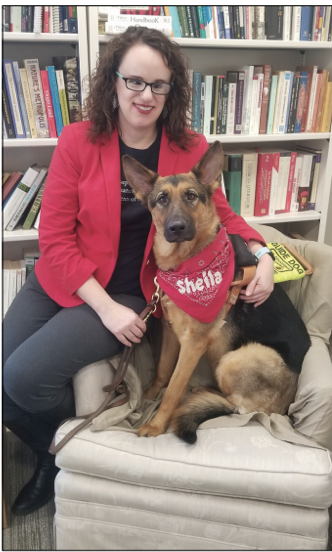
On the third floor of Barney Davis, the door of a large, sunlit office sits open and welcoming. Visitors are often greeted by Dr. Nicole Green, who inhabits the office, and, before last month, a large, cheerful German Shepherd named Sheila.
Green began working at Denison in 2022 and is the director of the Writing Center and an assistant professor. She is also legally blind— that’s where Sheila came in, until officially retiring from her duties last month.
“As a guide dog, her job is to, well… guide,” said Green. “Her primary job is to take me around obstacles, and also tell me when there’s a surface-level change… like steps, or a curb.”
Sheila has been Green’s constant companion since becoming her guide dog in 2018.
“It’s the closest bond that I will ever have,” said Green. “She’s my second guide dog, and I was extremely close with my first one. It takes a while to adjust to each other.”
Sheila’s arrival in Green’s life wasn’t entirely expected, either. Her first guide dog, Pumpkin, passed suddenly from cancer, and Green was still grieving when she met Sheila.
“[Sheila] is so incredibly loving and effusive and enthusiastic from day one, and she was like, ‘I love you right away!’” Green said. “I wasn’t emotionally ready to, but I needed to get a dog in the summer, when I had time off. She was very patient with me and waited for me to fall in love with her, and I did.”
Since then, Sheila has spent nearly every waking moment with Green, helping her teach, work, and live her daily life. Green said she often forgets how different her relationship with Sheila is from a relationship with a pet.
“I can just have a full conversation with her, like, ‘Do you have to go to the bathroom?’ And she’ll tell me in her body language and her expression. I know I can read her perfectly, and she can read me perfectly… It’s almost like we share a brain. But we also disagree sometimes and have arguments about what we should do,” Green said.
Julia Lerner, managing editor of “The Reporting Project” and a journalism professor at Denison, is Green’s office neighbor in Barney Davis. She’s shared a wall with Green for two and a half years, and said that she quickly became friends with Sheila and Green.
“I leave my door open most of the time, and all of a sudden, Sheila decided that she needed to investigate my office every time they walked past my open door. And so, fast friends, you know, because if a dog is dragging you into my very small corner office, we get to know each other,” Lerner said.
On occasion, Lerner brings her dog to campus, too, and said that Sheila would always be on the lookout for a new playmate.
“Sheila loves to poke her head in because I also have a dog. So, she’s coming in, she looks for my dog, Maya,” Lerner said. “She sees that I have dog toys on my carpet, usually, from when Maya is with me on campus… So she comes in, she’ll steal Maya’s toys. She’ll look for a snack. I got to know Sheila before I got to know Nicole, but they’re both so wonderful.”
Green also stressed that even though Sheila is retiring, she’s still in good health and is looking forward to relaxing at home for the foreseeable future.
“So, she’s perfectly healthy… She’ll be 10 in May, and so she’s just slowing down; she’s less interested in guiding. It’s a lot of stress on a dog. Because they know your safety is in their hands— in their paws, if you will,” Green said.
To get matched with a new guide dog, Green traveled to The Seeing Eye in Morristown, New Jersey, where she’d been paired with Pumpkin and Sheila. As Sheila was getting older, Green had been in contact with The Seeing Eye, preparing for the transition to a new dog.
After some meetings and trials to see which dog might fit Green’s schedule best, she was matched with Carli: a two-year-old German Shepherd-black Labrador mix.
Green said that Carli’s litter wasn’t even supposed to happen.
“It’s a very closely guarded breeding program. The breeding facility is like Fort Knox,” she said.
Somehow, Carli’s dad, a German Shepherd, escaped from his kennel one night and got into the female black lab pens. Since the puppies looked almost identical to lab puppies, no one batted an eye— until the dogs returned to The Seeing Eye from their puppy-raising families.
“They said, ‘Oh, these don’t look like normal labs. There’s something wrong with these dogs,’” Green said. “So, she’s my little bastard child. The reason Carli is so good for me is just because she’s really driven and really intense, obviously, because her dad was.”
While the change has been huge for Green and her dogs, Sheila’s absence and Carli’s arrival have impacted the students Green spends her time with— especially in the Writing Center.
“Carli immediately tucked into my office before she tucked into Nicole’s office, and Nicole said, ‘Oh, just like Sheila.’ So it’ll be interesting to see how the dogs are different from each other,” Lerner said.
Elizabeth Ham ‘26, an applied mathematics and theatre major from Pittsburgh, PA, is a student assistant director and consultant at the Writing Center. She said that working with Green and Sheila has helped her understand the best way to interact with service animals, especially when they’re working.
“I think the instinct to be friendly towards all animals is definitely there, but also recognizing that this dog has a different job than my pets at home do. So, learning [that] when she has her harness on, she’s working, and so you don’t need to be interacting with her like a pet,” Ham said.
Arianna Paredes ‘26, a biology and global health major from Georgia & Peru, is also a student assistant director and consultant at the Writing Center.
“A lot of the time we are able to interact with Sheila and Dr. Green when she’s off-harness, because we have our staff meetings in a closed room, so Sheila’s able to run freely. And in those moments, Sheila’s more like a dog. So we get to pet her and give her belly rubs. When she’s in her harness, I feel that what I noticed myself doing more is just being much more aware of her location and space,” Paredes said.
Sofia Monteleone ‘26 is a creative writing major from Oxford, Mississippi, and a consultant at the writing center. She said that having Sheila around has been a huge de-stressor in her daily life.
“Sheila’s existence brings joy and comfort, maybe stemming from the fact that it’s so constant. But also because she’s been a hard worker, and has been Nicole’s service dog for so long. She’s a support, for Nicole and for us especially at the writing center. Just looking at her makes me, at least, feel more comfort,” Monteleone said.
Students and faculty alike also had messages for Sheila and Carli, welcoming them both into new stages of their lives.
“Everyone was so excited to meet her, we’re also glad that, with it being the right time for Sheila to retire, that Nicole has a good new service dog to help her through the day. I think that… students appreciate the work that she does because Nicole’s such a great professor,” Ham said. “But also, the time where Carli’s not working. She’ll get so much time to get to meet all of Nicole’s students and consultants. And that I think it’s a good group of people to get to fill your life with.”
“Carli has big shoes, or big paws, to fill, but no pressure. Carli is just so energetic… and she’s all over the place, and she’s still early in the training process. Which is so weird to think about when I think about dogs, but… The more one learns, right?” said Paredes.
From 4:30-6:30 pm on March 12, the Writing Center will be hosting a retirement party for Sheila in room A07. Students and faculty can celebrate Sheila’s new stage of life, as well as Carli’s introduction to the Denison community.
“I do not expect anyone to bring gifts; they should not. However, if they feel the need, they can either bring a stick for Sheila to add to her stick library or they can donate to the Seeing Eye. In her name, cause they will take the donation in the dog’s name,” Green said.
Green said that the party will be an open house, and she hopes that anyone who knows her or Sheila will stop by to celebrate.
“Everybody is welcome. Anybody who’s had a connection to her, even if we haven’t actually met, anyone who felt a connection seeing her on campus is welcome,” Green said.