
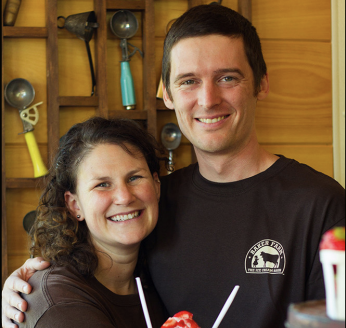
Jocelyn Seiter ‘08, Special to The Denisonian
To the Editors of The Denisonian,
I write as the spouse of a former Homesteader, a one-time summer Homestead resident myself and someone whose life has been profoundly shaped by the lessons learned on that small, remarkable piece of land in Granville.
The recent announcement that Denison intends to close the Homestead, just as it reaches its 50th anniversary, is not only heartbreaking—it is shortsighted. It disregards the Homestead’s history, its proven impact on generations of students and the extraordinary opportunity it represents for Denison’s future.
The administration’s stated reasons for closure include “waning interest” and a belief that the program “is not benefiting enough students for the piece of property it sits on.” These claims do not reflect reality. Even taken together, they fail to justify closing a place with such deep educational, historical and cultural value.
Anyone familiar with the Homestead’s nearly 50-year history knows that interest has always ebbed and flowed. Yet simply talking about shutting it down has sparked renewed passion. Spots are filling up, and more students want in. This is not a program in decline—it is a program starved for support, not demand.
To suggest there are no future plans for the cabins or land—only that the Homestead will quietly disappear—is even more troubling. It dismisses decades of student labor, love and learning poured into that space. It erases a rare ecosystem of community, sustainability and hands-on education that exists almost nowhere else in American higher education.
The Homestead is not a liability. It is a missed opportunity.
For half a century, students have lived what many universities merely talk about: sustainability, intentional living, community accountability, conflict resolution, local food systems, ecological literacy, resilience and collaboration. Students chop their own wood. They raise chickens. They grow food. They make decisions collectively. They build structures with their own hands. They learn to live in community—truly live—and to steward their environment in ways classrooms alone cannot teach.
This is the kind of program universities dream of marketing.
This is the kind of program parents brag about.
This is the kind of hands-on, real-world experience that employers value.
And this is the kind of program that makes a university stand out in a crowded, competitive landscape.
Why eliminate one of Denison’s most unique, most powerful and most inspiring experiences?
My husband lived at the Homestead for many semesters. It shaped every part of who he is: how he understands community, how he approaches sustainability and how he lives his values in real, tangible ways. After graduating, we built a business rooted in the lessons he learned there. We make handmade ice cream on a Massachusetts dairy farm, using as many local ingredients as possible—because the Homestead taught the power of supporting local food systems. We installed solar panels on our roof because sustainability isn’t abstract; it’s lived there every day. We also use compostable packaging, carrying forward the Homestead’s lesson that caring for the earth isn’t just a class discussion—it is a way of life.
The lessons my husband took from the Homestead did not end with him. They now reach the next generation of young workers, learners and community members through our business. We currently employ over 70 people each year—people learning the value of their voices, the rewards of hands-on work and the power of intentional, sustainable systems. The ripple effect of a Homestead education extends far beyond its cabins: it enters workplaces, communities and families, shaping lives long after students leave Granville.
Our story is not unique. Homesteaders across generations echo the same sentiment: “The Homestead changed my life.”
I saw it myself when I lived there that one summer and helped build Cabin Phoenix. That work grounded me. It taught me what it means to live in connection with the land, with others and with myself. It is something I will carry forward forever.
The Homestead is not just a living option. It is a legacy.
It is a classroom.
It is a community.
It is a catalyst for the kind of learning Denison claims to value: experiential, ethical, progressive and rooted in real-world engagement and responsibility.
The Homestead is profoundly welcoming by nature. Students, faculty, alumni, community members—even curious visitors—have always been invited to join dinners, work parties, conversations and moments of connection. It is a place where people learn together, eat together and grow together. A place that expands Denison’s reach far beyond campus.
The outpouring of support from students, alumni, professors and town residents is not nostalgia. It is recognition that this is something rare and precious. You cannot buy the kind of goodwill, positive press and national distinction the Homestead generates organically.
Instead of closing it, imagine what Denison could achieve by investing in it.
Imagine what it could become in the next 50 years.
Denison has the chance to honor a living tradition, amplify a program that embodies the university’s stated values and listen to the extraordinary chorus of voices asking not for something new, but for something profoundly meaningful to be saved.
Please do not extinguish one of the university’s brightest sparks.
Save the Homestead.
Strengthen it.
Celebrate it.
And let it continue changing lives, just as it changed ours.
Sincerely,
Jocelyn Seiter
Spouse of a former Homesteader
Homestead Summer Resident
Patricia Beals
Thank you for sharing your story Jocelyn. My daughter currently lives in Phoenix and has found not only a great sense of community on the homestead, but also a growing passion for living more sustainably and with purpose. I agree there are so many opportunities that could be built in this space. It is a gathering space where meals are shared by many students on campus (I recently witnessed over 70 students, including a group from Kenyon college come to the community dinner on a beautiful Friday night) – but also a place where sustainable practices are in place that can be learned from. The homestead could act as a learning space for various classes with more of the land used by students to grow food and test out sustainable building practices. Could this land be turned into a small campus farm? Could businesses be created where students grow food, flowers, tend bees and harvest honey to be sold on campus? There are so many possibilities in a world where we should be prioritizing the health of the planet and the way we use its resources. The homestead is such a unique feature at Denison that sets it apart – and has made such a positive difference in my daughter’s experience in college. I hope that others will speak out to preserve something that is both unique and special – and maybe other Universities would be inspired to create their own homesteads.