
Donald Keough, Editor-in-Chief
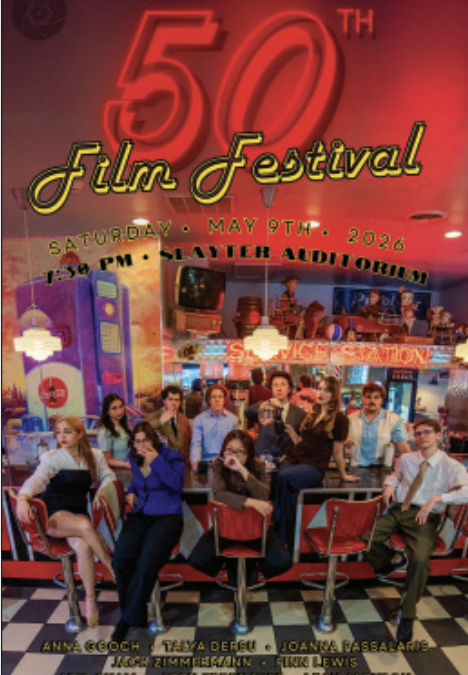
The Denison Cinema Department will present the 50th film festival, an event which includes a compilation of student films made throughout the semester.
In many ways, the festival serves as the “capstone” project for graduating students, and all are welcome to attend to view the students’ work.
Beyond showcasing a collection of films, there’s a number of elements that go on behind the scenes to create the film festival.
“For those who are primarily focused on film production, this really serves as their capstone experience,” Marc Wiskemann, an associate professor and co-chair of the cinema department, said in an email response.
Since its inception, the film festival has served the same purpose: to highlight and kindle what students have learned throughout their class experience within the department.
The festival will be in the same format as previous years, where student films are compiled into one film. Even though it’s similar to previous years, current students have still found significance in it being the 50th festival.
“I’ll only have been in one workshop class ever, and so having that be the 50th anniversary, after four years of the cinema department, not really defining who I am, but helping me find who I am… I think there’s something beautiful in that, and in fact that we’re all here together, and we’re just a group that works really well together in a lot of ways,” Anna Gooch ‘26 said. “I think that’s something really special.”
“At its core, the Denison Film Festival represents a culminating achievement for our students,” Wiskemann said. “It is where years of learning, experimentation, and growth come together in a public and celebratory way.”
The first festival dates back to 1967, when film courses were being offered in the Department of Theatre Arts. Following the creation of the cinema major in 1968, the festival was revamped and eventually became an annual event.
The festival organization, as well as the film productions, are part of a workshop class students enroll in. Although much of their time goes into making their film, Wiskemann also said a significant amount of their time goes into preparing the festival.
“They coordinate all aspects of the festival, they design the poster and invitations, they curate and schedule the films, manage promotion, and work hard to ensure a professional presentation,” Wiskemann said. “This active involvement is an important part of the course, and gives students practical collaborative experiences that extend beyond filmmaking.”
This year’s film workshop is being led by Wiskemann. In addition to his guidance, students are the driving force behind the creation of their films. So far, Gooch said she thinks it’s been a good environment to learn more about herself as a film maker.
“It’s definitely taught me what I enjoy and what I don’t enjoy,” Gooch said. “It’s definitely the most unique class that I’ve taken, probably at Denison, and in just the way that so much of the work is on our own time.”
One part of the class she’s enjoyed the most has been working together with her classmates.
“I think working in a group, working from the ground up, having a creative board where you talk about ideas… everybody gets their voice to be heard and uplifted over time and throughout participation,” Gooch said.
In the past, Gooch has been overwhelmed by the number of opportunities in the film industry, given the array of different tasks that go into producing a film. But having a semester to work on one movie has given her the chance to figure out what part of this process she loves the most.
“I really fell in love with the planning and organizing and production aspects of organizing a film and organizing and collaborating within a group,” Gooch said.
They’ve coordinated things like photoshoot at a 50’s themed bar for the festival’s poster, and each student has pitched in through different ways, such as Henry Clary ‘26 putting up wanted ads for actors on Facebook.
“I think the best takeaway from this class is how close we’ve all gotten,” Jack Zimmermann ‘26 said.
They have a group chat they use every day, where they discuss more than just logistics and questions.
“It’s like, ‘Hey, we’re going to this party at this time if anyone wants to show up,’” Zimmermann said. “Just hanging out with new people and getting close to them, because we really have to do everything together. It’s kind of fun to work with all these other filmmakers.”
Creating the festival is also daunting for some of the students. Gooch said that having a vision that you’ve thought about for so long, and then having the opportunity is in your hands is very nerve wracking for her. But the way the class breaks down the filmmaking process step-by-step has helped.
“Every week you have a certain homework assignment or something that you should be working on that you should see progress in the next week by the time you come back on Friday, and so that’s helped,” Gooch said. “It’s definitely shown me my strengths and what I appreciate and what I enjoy and love doing in film, but it’s also shown me my weaknesses.”
Getting to do every part of the process of filmmaking has highlighted what kind of filmmaker Gooch would want to be. Zimmermann also agreed that this process has been helpful, and that it’s unique to Denison.
“At bigger film schools, you’ll usually go in with a focus, like, ‘Oh, I want to be a screenwriter,’ so all you’ll do is writing and maybe some behind the camera, but you won’t touch sound, you won’t do any lighting,” Zimmermann said. “Denison does teach students everything because it’s more tight knit and small.”
Seeing the festival come together is something that both Gooch and Zimmerman are anticipating. The professors, like Wiskemann, are also excited to see the student’s work this year.
“In many ways, the festival screening marks both the culmination of the academic year and a transition point for our seniors as they move from their time at Denison into their professional lives,” Wiskemann said.