
Nora O’Byrne, Features Editor
Nestled among the leaf-covered forest floor, the shadowy creature reveals only a pointy snout and bushy tail before disappearing back into the night. For Lee Winkler ‘28, discoveries like these begin with a willingness to look a little closer.
“Just noticing what’s around you, and what could be around you, makes you more observant,” Winkler said.
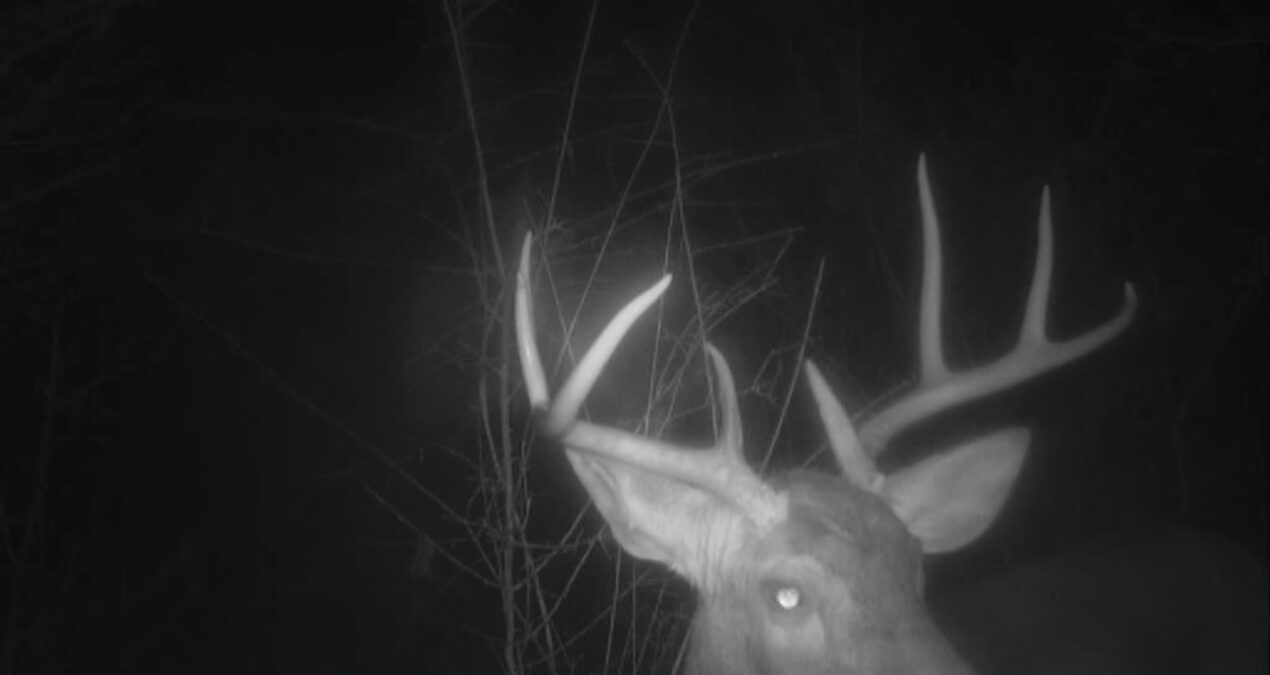
A birder at heart, Winkler initially sought a way to track bird species in Denison’s Biological Reserve, a 350-acre ecological haven for local fauna and student researchers. That’s when Winkler’s advisor, Dr. Geoff Smith, suggested setting up wildlife cameras.
“I wanted to do something with birds, and [Dr. Smith] said, “Well, I know how these cameras work!’ He had a map of cleared areas in the Bio Reserve. It’s more of a proof of concept; can we actually capture anything on these cameras? The answer is yes, which is good, but it’s in its early stages right now.”
In the early weeks of the fall semester, the cameras were set to take photos every 15 minutes.
“That was not fruitful, because it wasn’t motion accurate. It was kind of random, so there were a lot. We switched to motion, but it’s going 24/7. It’s only when there’s motion will it record a little bit.”
Now, there are six cameras stationed throughout the Bio Reserve. Originally intended to monitor birds, most were positioned at shoulder height. Winkler has since moved them closer to the forest floor.
“When an animal walks in front, [the cameras] capture it,” Winkler explained. “We’re trying to see the abundance of— well, we started with birds, but we’ve gotten genuinely one bird, so we’re moving to how abundance of foragers, like mammals, changes when in an area that has a lot of invasive plants versus an area that has a lot of native plants that’ve been cleared by invasive plants.”
While the data ultimately proves that invasive species need to be removed, Winkler hopes it might reveal insights into what helps or harms local animal populations.
“Originally, we were thinking, ‘Oh, honeysuckle is just sugar.’ When birds eat it, it’s like fast food. We’re thinking we’ll get a lot during the migration, and that in tandem with some other data could prove interesting. But I have not gotten very many birds, so now it’s just about foraging and that kind of thing.”
With every species the camera picks up, Winkler tracks it in a Google Sheet. So far, common species include deer, squirrels, chipmunks, and rabbits, with the occasional surprises.
“I’ve captured I think four instances of a flying squirrel, which is more than I thought I would get because I thought they were super rare,” Winkler said. “We got one frog in a tree. That was a really strange moment because, why are you up there?”
Around 6:45 p.m. on Oct. 28, an unidentifiable pointed-snouted creature appeared in the footage before disappearing behind a tree. While Winkler suspects it was a skunk, its identity remains uncertain.
“I know we had that skunk maybe, but I really want to see a skunk for sure,” Winkler said. “At the Bio Reserve, I was out there and we saw a muskrat in the pond. I know the chance of him being on camera is very small, but I really want to see a muskrat! We managed to get a coyote and a raccoon, so that’s pretty good too.”
Growing up, Winkler was an outdoors kid.
“When I was a kid, I would spend forever outside, much to my dad’s chagrin,” Winkler said. “I would take apart his retaining wall to look at bugs. I’ve always been outdoors. I’ve liked biology the best out of any subject forever. I like hiking. I don’t mind mosquitoes. I’m just naturally built to be outside.”
In 2025, Winkler started their wildlife photography account, @winkandyoullmissit. Receiving their camera before their first pair of binoculars, Winkler initially used photography to get a closer look at the birds.
“I like taking photos, and it’s fun to frame the photos and try to capture a bird in its essence,” Winkler said. “But they’re also very finicky. They fly away so fast, and they’re not nice subjects.”
Winkler’s favorite part of the hobby is its endless opportunities to discover something new.
“There’s just so much more to learn. The more birds I see, the more I’m like, ‘OK, I have so many more!’” Winkler said. “There’s so much out there to learn about, and you’re not gonna learn it all your lifetime, even if you try really, really, really hard. There’s just always something to strive for, keep that goalpost moving, and learn as much as you can.”
With Thanksgiving break on the horizon, Winkler and their advisor are weighing whether to relocate the cameras, take them down at the end of the semester, or reposition them at the beginning of next semester. Regardless of the decision, the Bio Reserve will remain their home base.
“On campus, it’s not a natural environment. There’s so many humans,” Winkler explained. “While there is a lot of human foot traffic, there are areas where nobody goes. So, it’s easier to get a read on actual abundance of wild animals.”
Winkler believes the cameras offer a glimpse into a side of nature that would otherwise go unnoticed.
“It gives you an insight into nature without the disturbance of humans that you really just can’t get on a hike, because a lot of the creatures are wary of us,” Winkler said. “They aren’t relaxed if we’re on a hike, so being able to record them when they’re just hanging out offers a really good insight into their behavior and what they do when we’re not around.”
The Bio Reserve is open to Denison students from dawn to dusk every day. Winkler hopes to see more students take advantage of the natural space right in their own backyard.
“Go out there and go walk! It’s so beautiful with the fall foliage too, and it is genuinely easy to walk there,” Winkler said. “You don’t have to cross any roads either, which I personally hate. People should get out there and live it up!”