
Eva Altizer, Staff Writer
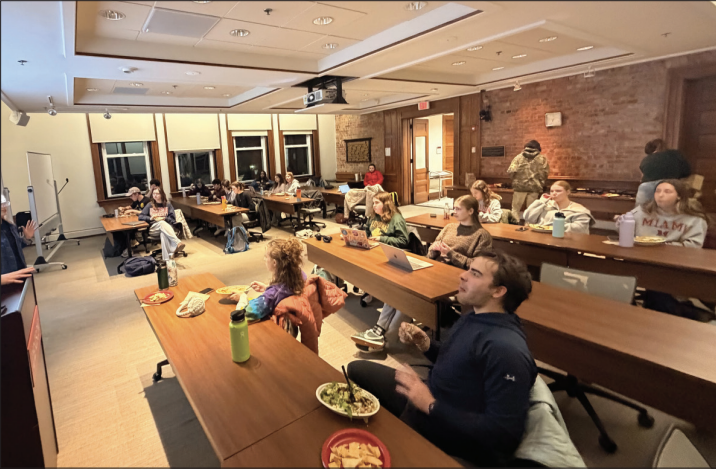
On Feb. 24, the Denison Debate Team and the Green Team hosted a crossover event on the ethics of AI use on campus.
With the addition of Chipotle Mexican Grill catering, a fairly sizable crowd of participants was drawn to the event.
In Barney-Davis Hall, room 212, students sat at long tables before a projector with a list of questions such as: Should AI use at Denison be limited because of its environmental impacts? Is it ethical to use AI for non-essential applications during a climate crisis?
These questions posed interesting answers. Participants were bringing the definition of “non-essential” AI into question, and whether AI is essential at all—and “DenAI,” an AI program that has been developed for student use at Denison—and was unknown to most students.
According to an article on the official Denison website, written by Ginny Sharkey ‘83, director of institutional communications, the DenAI pilot model is being tested by faculty and students.
“I thought this was an extremely productive conversation, and I’m glad that a lot of people were able to show up,” said Lyaila Penn ‘29, who was a major participant in the debate.
Most of the debate consisted of students who were against the use of AI at Denison, but the conversation was not without nuances.
Many students were aware of universities and businesses feeling pressure to keep up with “the cool new thing,” even if the technology is controversial.
“We are an academic institution, right? So instead of just trying to blend in and catch up with the times and ‘Oh, let’s be hip and cool with the kids and make DenAI [to replace] ChatGPT,’ they could focus on why students are using AI,” Penn said.
One major point of the debate was the environmental damage done by AI data centers, and what the responsibilities of the consumer are.
A point brought up by Charlotte Meyer, ‘26, one of the Green Team student leaders who was a part of the discussion, was that the true brunt of the burden does not lie with individuals, but with the powerful.
Another side of the issue that is often ignored is ecological racism.
“One of the points that was brought up, is that data centers are being put up in places where Black and brown people live and poor communities, and that was something I kind of knew about, [but] it didn’t really sink in that this was a big societal problem with these data bases,” Ella Sloat ‘28 said.
Beyond the negative impacts data centers have on the climate crisis, they can also cause pollution and water shortage in the communities where they are placed, and Penn posed that this issue disproportionately affects people of color and rural communities.
Ultimately, the debate was not for the purpose of definitively deciding the right opinion or course of action, but rather to urge students to consider how they use and think about AI, and how they want the world to move forward with AI in it.