
Ella Kitchens, Editor-in-Chief
Following a high school science teacher and students taking action in a Land Lab, reflecting on tree communication, and studying the return of bobcats were all a part of students’ experience in Doug Swift’s investigative journalism class.
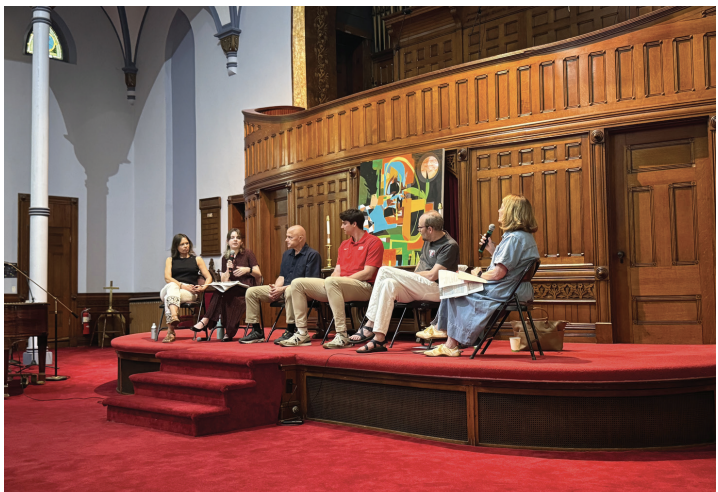
Denison’s journalism department and The Reporting Project held a panel on the series of stories at the United Church of Granville on April 16. The event also served as a fundraiser for The Reporting Project, Denison’s nonprofit newsroom, raising over $13,000 through donations and a silent auction.
Denison students and members of the community were in attendance, with pews in the United Church of Granville filling up quickly.
“The day of [the panel] was a lot, but it was fun to do,” said Doug Swift, visiting assistant professor of journalism.
Connie Schultz, professor of practice of journalism and a Pulitzer Prize-winning journalist, moderated the panel. During the panel, she asked what inspired the name of the project “The Land Remembers.”
“We wanted a title that had a little bit of a promise,” said Swift. “Just give nature a chance. It does come back, it will come back.”
Patrick Fitzgerald ‘26 talked about his story on teacher Jim Reding’s Land Lab, an outdoor classroom for Licking County students. Reding also spoke on the panel about what he does and how passion for the Land Lab drives his students.
“When [students] get to kind of go outside their own comfort zone, they get to try something that they’re interested in, but it isn’t necessarily assigned to them, when they do something that isn’t graded, it’s just a passion that you find, that’s when all of sudden they realize ‘What I’m doing right now really matters’… It’s no longer school. It’s something that they’ll be doing at 12 o’clock at night before they fall asleep,” said Reding.
Also on the panel, Margo Ellis ‘28 talked about her story on the state of forested land in Licking County, and ecologist Shauna Weyrauch talked about her research on bobcats.
Swift had taught this investigative journalism class before, with a focus on recycling practices in Licking County. But since that class was taught in the spring, it was difficult to do a follow-up event on it. He was excited to hold the panel this time.
“The thing about investigative journalism is you learn things you didn’t know, right?” said Swift. “That’s my selfish reason for doing it. And… I’ve always loved nature, I’ve loved being in nature, but I really appreciated the biodiversity idea.”
“Doug Swift is the heart behind this whole project — a labor of love — investigating and telling the stories of the natural history of Licking County,” said Beth Lossing, assistant director of journalism at Denison, in an email response. “He engaged students over an entire semester to help them research, report, and craft the narratives and photos that fueled the project.”
Lossing worked to support and coordinate the event down to the smallest organizational details.
“I wanted our guests and community to feel warmly welcomed and cared for through food, hospitality and attention to the details,” said Lossing. “I helped the team think through logistics from greeting to presenting silent auction items to handling donations.”
Guests at the event said that they enjoyed both the event overall and the content of the panel.
“We have two daughters who went to Granville schools and so they really benefited a lot from the Land Lab that Mr. Reding was talking about that he originated,” said Mort Guiney.
“I’m involved with the Licking Land Trust so I’m super interested in land preservation, green space and all that,” added Amy Mock, a board member of the Licking Land Trust.
Both Mock and Guiney said that they went into the event unsure of what to expect.
“[The event] more than met my expectations,” said Mock. “I liked the mix of speakers and having those students and people coming from different perspectives.”
“[There were] more people than I expected, which is great,” said Guiney. “That was the biggest difference between my expectations and experience.”
Lossing expressed gratitude for journalism professors Jack Shuler, Connie Schultz, Alan Miller, Julia Lerner, and Lucy Bryan for their contributions to the event and to The Reporting Project.
“I think the end result was excellence,” said Lossing. “It took the entire team doing what they do best.”
“Hopefully more people will support pollinator pathways and the Licking Land Trust and it’ll resonate outwards,” said Swift. “You hope journalism has that effect. For right now in this room, it was just beautiful.”