
Donald Keough & Margo Ellis; Editor-in-Chief & News Editor
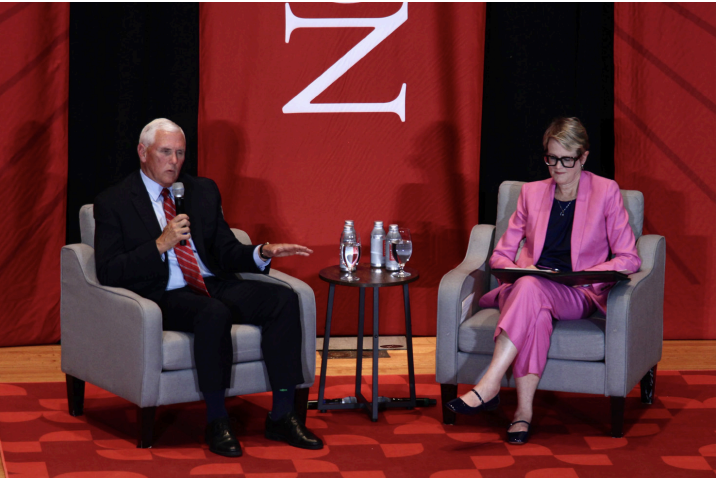
After speaking to a packed audience in Swasey Chapel, former Vice President Mike Pence came off the stage to talk with attendees on April 15.
His talk beforehand– where he answered moderated questions– discussed his career path intertwined with a devout adherence to Christianity and traditional conservative values. But students took the chance while he was off the stage to ask questions which deviated from the talk.
One student asked for his thoughts on coming to Denison, where students are more often considered to be left-leaning rather than conservative.
“I was very intrigued about the Babcock lecture, because it was established and endowed, essentially, to bring conservative voices onto campus,” Pence said. “It’s been around for a while. So you have a lot of universities that are trying to make sure that there’s diverse voices on campus, and there’s progress being made, and I’ve tried to be a part of it.”
Ultimately, Pence’s time was spent doing just this.
Pence visited two classes earlier in the afternoon: Dr. Andrew McWard’s “Introduction to Global Governance” and Dr. Yunus Orhan’s “The End of Democracy?” which were both held in the Burton Morgan lecture hall to accommodate the former Vice President and his team.
Elliott Grenier ‘26, a student in Orhan’s class, said that Pence’s in-class visit was mainly question-led, in which students were prompted to direct class-related questions to Pence.
“The points I feel he emphasized were just the need for civility,” Grenier said about the class visit, prior to the talk in Swasey. “He had a more optimistic view of American politics.”
Grenier also said that he found Pence’s remarks to be interesting and thought provoking.
“I’ve met people high up on the totem pole before, and they’ve always struck me as odd, but despite what I knew about Mike Pence… he radiated basically what he preached: calm and civility,” he said.
Kaleigh Coffman ‘29, a student in McWard’s class, said that she enjoyed Pence’s class visit.
“I’m really happy that he was able to come to campus,” she said. “So that people, especially in the class, could ask him questions and see what a real politician’s responses would look like.”
Coffman also recalled that Pence complimented her “The Office” themed stickers on her laptop.
“I enjoyed… learning that he likes ‘The Office,’ and how chill he was. He seemed very excited to be talking to us as college students,” Coffman said.
Following the exclusive reception with faculty and a small number of students, audience members filed in through a security checkpoint before the talk began.
The talk started with Pence remarking on the beginning of his career, noting that he started as a Democrat in 1975. He said that he considers himself a “Christian, Conservative, Republican,” in that order, and similarly within the classroom, he emphasized his belief in the importance of civility in politics.
“I hope in my public life for 20 years, first and foremost, is evidence of that principle, treat others the way you want to be treated,” Pence said. He also said that he holds the view that negative personal attacks have no place in American public life.
During the talk, he also said that he has been inspired by the lives of President John F. Kennedy and the Rev. Martin Luther King Jr. Despite differences in political views, Pence cited these individuals as influential civil servants.
Among the pews in Swasey, after his talk, Pence spoke briefly about the state of journalism and media in the United States.
Echoing a sentiment originally attributed to Thomas Jefferson, Pence emphasized the importance of free press in democracy. “‘If you gave me the choice between a society with free press and no government and a society with government and no free press, I would choose the former,’” he said. “That’s how central, in the minds of the authors of the Declaration of Independence, a free and independent process is.”