
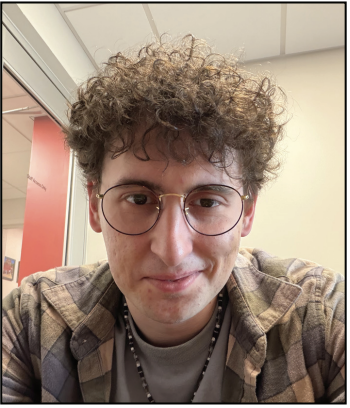
Seby Newman, Special to The Denisonian
Talking to people who have fundamentally different life experiences and expectations for the world has always been a fascinating subject to me.
It really feels like there are an infinite amount of identities a person can find themselves belonging to, whether it’s along the lines of race, gender, sexuality, lifestyle, location they grew up, activity, religion, or any other category of “thing” that someone might use to describe who they are or what they believe.
The endless possibilities can quickly make two people from different enough backgrounds feel like they live in two entirely different realities when speaking to each other. Even on a campus like Denison where everyone on paper has many similarities; everyone is relatively the same age and starting the journey of their young adult lives, everyone is here for an education, and everyone here lives at max 15 minutes away from each other on foot. Despite these similarities, the fundamental differences between social circles are immense and noticeable. For example, the culture and social norms/life within any of the sports teams, male or female, will differ vastly and immeasurably from the way the people involved in Denison’s arts programs behave. Mitchell and Eisner are on different sides of The Hill, but the students all sleep in the same dorms, right above, beside, and below each other, living in completely different worlds.
You can probably imagine the extent to which the personalities and social expectations between a theater student and a lacrosse player are almost completely and utterly incompatible with one another (which is also seen in the differences of how both groups get made fun of by the rest of the campus). Both are Denison students 24/7, both living in completely different realities.
And then, there’s politics. How is the theater student and the lacrosse player going to interact with each other, when they not only don’t have the same life experiences, both before and at Denison, but when a subject comes up like Trump? Or abortion? Or the Israel/Palestine conflict? Or any other already potentially inflammatory, rage-inducing subject?
We all know the answer; they simply don’t. They don’t interact with each other. They have quite literally nothing to say to each other, the differences are far too large for them to be able to communicate effectively on anything, to the point of having zero interest in even being in the same room with each other.
I think this breakdown in communication is one of the main driving issues of our time. If we can’t even talk to each other at a college campus, where theoretically we are all literally paying thousands of dollars precisely to learn new things, so that we can go back into society having educated and “smart” opinions about how the world works, if we can’t even do it here, then I mean, no wonder the rest of America can’t. We have come to a point in time where communication with people different from ourselves really does feel impossible, and at an era in time where arguably the stakes have never been higher, at least for our generation.
To be clear, this is not an opinion piece intended to blame either side of the political aisle for this divide, or take the reasons behind this divide lightly. I’m not saying “guys just talk to each other and our problems will go away.” This is an incredibly hard subject for many reasons. But I personally don’t see another choice. I think there has to be a possible way for people to have a discourse around disagreement, or eventually both political sides are going to be continuously pulled farther away from each other until real, irreversible violence is happening on the streets. It’s already starting to happen, depending on what media/news source you listen to and believe. The main reason discourse feels impossible is because it seems that some fundamental differences are too fundamental to ignore. When someone’s identity in any shape or form feels personally threatened, whether it’s religion, livelihood, race, gender, sexuality, or any other aspect of someone’s perception of who they are, civil discourse no longer feels like an option, and we are all so bad at recognizing or empathizing with the version of it happening furthest away from ourselves. So is it even possible to break that cycle? Or are the differences forever too far from each other that we’re doomed to fight each other over them?
It is important for me to acknowledge that the ability to discuss these kinds of issues in a civil manner comes from an immense place of privilege. It is precisely because for whatever reason my identity does not feel immediately threatened by a different opinion that I can then interact safely with that opinion, on either side of the aisle. And what I’ve found from doing that, is that it is in fact possible to get people to listen and understand what you believe, maybe even reflect and change how they see things. It’s possible. So long as they are being listened to in the process, and you are allowing them to feel safe in accepting their life story as well. It’s hard. Of course it is. This doesn’t fix much on its own, except for the slight reminder that the people on the other side are also just humans, trying to figure the mess of life out in their own way, and they don’t have to be the enemy, not forever.
I’m leaving all of this intentionally vague, because specifics are not the point here. If anything, I’m trying to call on those who feel brave enough to understand, who are willing to admit they don’t have all the answers, who are willing to hear opinions that might hurt them. I don’t have the answer, but I know hating each other from the safety of our own bubble isn’t going to work long term. There has to be something we can try.
Seby Newman ‘28 is a creative writing major from Washington, D.C.