
Annika Young, Staff Writer
“Weinberg, Weinberg use your head, we want you to save the Stead.”
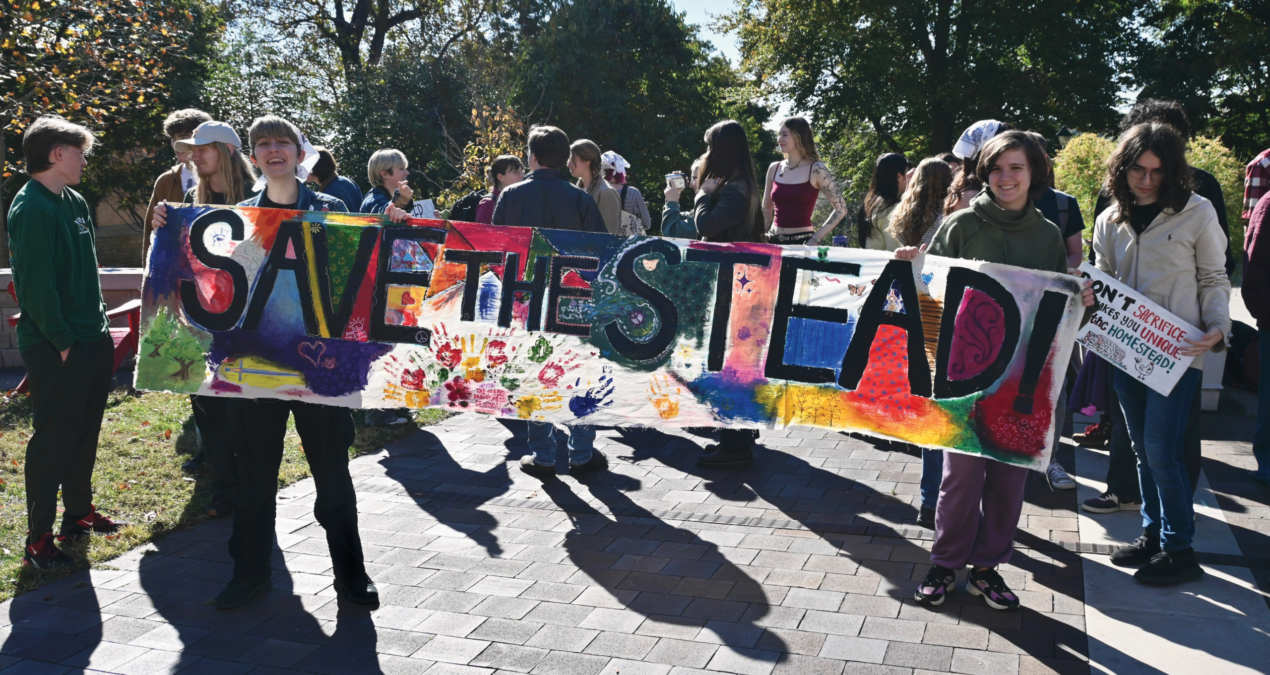
This chant echoed across Denison’s Academic Quad on Thursday, Oct. 22, as students, faculty and alumni gathered at the flagpole outside of Slayter Student Union to protest the impending closing of the Homestead.
At 11:30 a.m., organizers of the “Save the Stead” demonstration and rally met the growing crowd with a variety of handmade signs and student speakers.
In 2025, the administration announced the decision to close the Homestead after the spring semester of 2027. This initiative is headed by Senior Associate Vice President of Student Life Dr. Nicole Ausmer, Vice President of Student Life Ric Hall, and President Adam Weinberg. Their main reasons contributing to the shutdown were detailed in an email sent out by Denison Campus Governance Association Vice President Zacc Greene ‘27, on behalf of himself and President Emmanuel Rodriguez ‘27. The email summarized the rationale into three main points: significant long-term investments in staffing, programming, maintenance; participation and mental health; and health and safety concerns.
More than just the “Homies” (what those who live at the Homestead call themselves) care about the looming shutdown. Many students, alums and faculty feel that the closing is unnecessary and even detrimental to Denison as a university.
Attempts to save the Homestead have been ongoing since the first announcement of shutdown. Many meetings have been held between Homies and various administrators, as well as meetings between admin, alums, and student trustees. This October, the “Save the Stead” campaign entered a new phase of activism. Key organizer and Homie, Jakob Loche ‘27, explained that all month led up to the demonstration and rally. Students tabled in and outside of Slayter, handing out information cards and stickers for their cause.
Loche explained that the Homies all played large roles in planning different elements of the display. Those who lived in the Homestead over the summer began to seriously build out the “Save the Stead” campaign. Homies organized the campaign into teams with on-the-ground strategies, and explored methods to actually pressure the university rather than having what Denison alum Max Bonsteel ‘26 referred to as “circular discussions” with the administration.
Loche said that some of the Homies have attended training in Kansas with an organization called Campus Climate Network. On the website, the organization states that they “equip student leaders with hard organizing skills, political education, and tools for emotional resilience in the face of crisis that enable them to build durable power on and off campus.”
The training helped shape the campaign’s approach to organizing, shifting its focus beyond raising awareness and toward building collective student influence. For organizers, the demonstration and rally was an opportunity to show the administration that opposition to the shutdown extended beyond the students directly involved in the Homestead.
“We need people in order to pressure the university and deal with that power imbalance so that we actually can take at least some of the power to make decisions,” Loche said.
The demonstration included volunteer speakers from those who felt passionately about the cause. Dozens of students gathered around the speakers, faculty listened in from the outskirts and passerbyers asked questions and joined the group.
“We needed a public show of support, some instance that we can point at and be like, we got this many students,” Loche said.
After roughly an hour, appointed marshals directed the group to begin the rally. The rally began at the flagpole, marched down to the library, looped around and made its way to Reese House where the Board of Trustees were meeting. While marching, the group had various chants such as “Save the ‘Stead, Save the ‘Stead,” and, “Weinberg, Weinberg use your head, we want you to save the Stead.”
After making their way to Reese House, they taped “The Homestead Manifesto” to the front door. “The Homestead Manifesto” focuses on maintaining the liberal arts education values with three points. Point I, to save the Homestead and reverse the plan to shut down the Homestead, point II, to support sustainability by making a “public, transparent commitment to reinvest in sustainable initiatives on campus to achieve the established goals of carbon neutrality by 2030 and net-zero emissions by 2045,” and point III, to secure student power, which calls upon improving transparency and accountability between Denison administrators and the student body.
“We hope that they will take a look at our list of demands in our manifesto that we’ve taped to the door, and consider with an open mind what we’re saying and that they should take student opinion to heart because we’re the ones they are supposed to be serving,” Homie and organizer, Lily Meyer ‘28, said.
The manifesto was taken off of the door of Reese House that afternoon. There has been hope from organizers that the manifesto can open further conversations about the Homestead’s future. But, while students hoped the public display of support would encourage administrators to reconsider, the university currently maintains their decision to close the Homestead.
“We’ve been in close conversation with concerned students and alumni about this for some time now. The decision to conclude Denison’s Homestead program in its current form was driven by several factors, including declining student participation over many years and the significant long-term investments needed to sustain the program and its facilities,” said Vice President for Student Life Ric Hall. “While the current program will conclude next spring, we are continuing conversations with students and alumni to explore new opportunities that honor the Homestead’s history and preserve its spirit.”
While the administration cites declining participation and the costs of maintaining the program, students and alumni argue that closing the Homestead would mean losing more than a place to live. For many, the Homestead represents more than a residential program: it is a defining part of Denison’s identity and a model of student-led community.
For opponents of the closure, a main concern is not only whether the university can afford to maintain the Homestead, but what Denison may lose by shutting it down. Bonsteel questioned the long-term value of the decision, arguing that the Homestead offers something increasingly rare in higher education
“The Homestead among any undergraduate institution in the country is a completely unique thing with massive history behind it. What benefit are you getting from the Homestead closing? Because life on campus isn’t getting better,” Bonsteel said. “I saw over my four years, the only consistent element was student choice going down…If I lose the Homestead, I lose my connection to Denison, because I feel infinitely more connected to Denison than I would if they closed it.”
Demonstrators see the decision as part of a larger debate about the type of institution Denison is developing into. They argue that preserving the Homestead is inseparable from preserving the values of a liberal arts education, including student agency, sustainability and community.
“It is larger than the Homestead. What is at stake is the university is walking away from their commitments to a liberal arts education, and we need to, at some point, stick our feet in the ground and say no more,” Loche said.
As administrators continue conversations with students and alumni about the program’s future, organizers are urging the campus community to get involved before the planned closure.
Meyer said, ”I would really, really encourage people to come out and learn about [the Homestead], especially since if admin continues with this decision, this might be your last chance.”